


Love tarot can offer a quiet space to explore what connection means to you. The cards may bring a feeling, a hope or a difficult question into focus, especially when your thoughts have been circling the same uncertainty.
This five-card reflection spread keeps the attention on your needs and choices. It does not need to reveal another person’s private thoughts to be meaningful.
Begin with a question that leaves you room to act
Instead of asking whether someone is destined to love you, try “What would help me approach this connection honestly?” If you are single, consider “What kind of relationship do I want to make room for?”
You can use your usual prayer, intention or shuffling ritual. Choose a time and place where you can reflect comfortably. A quiet corner and a familiar deck are enough; you do not need an expensive setup.
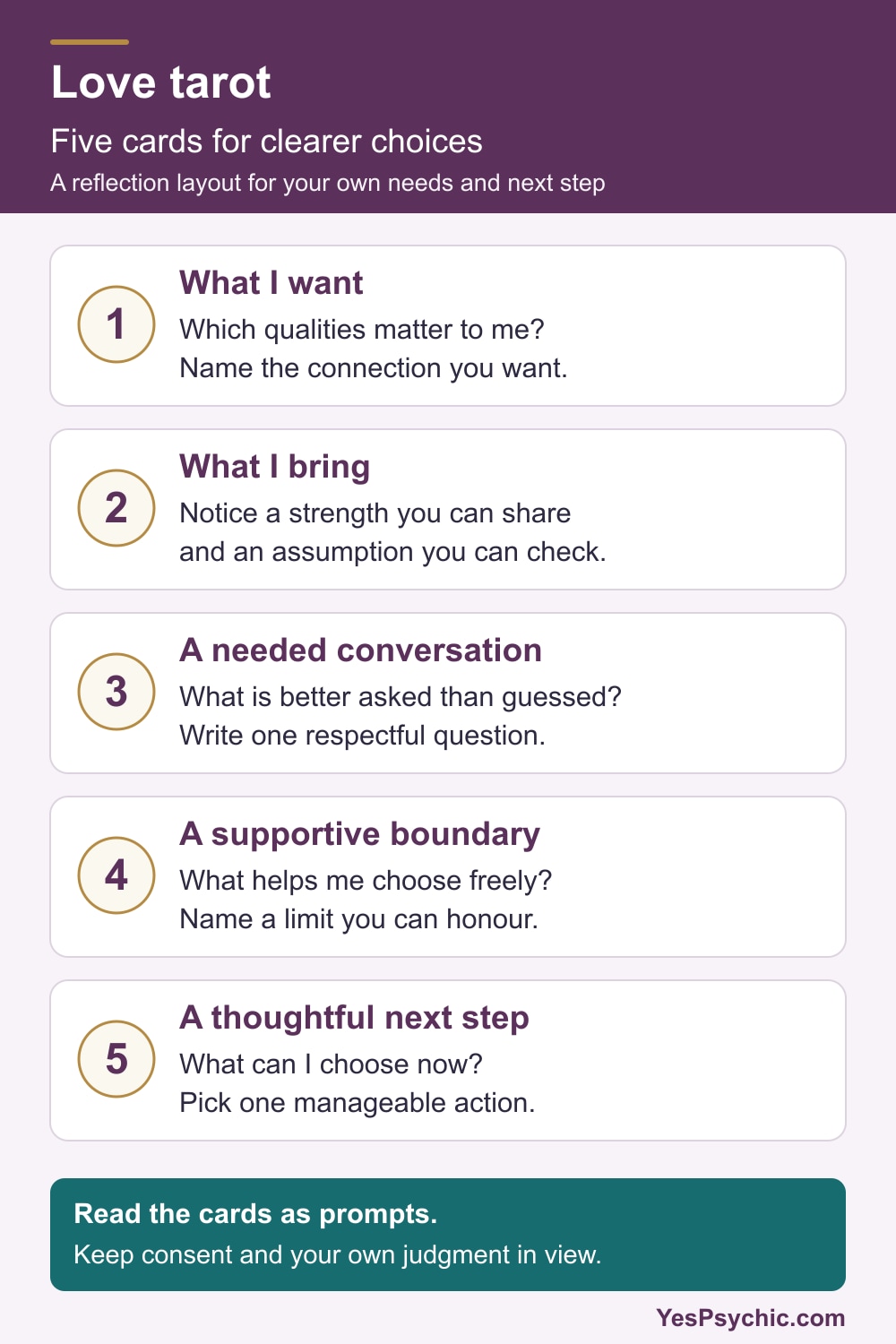
Lay out five cards in a row
This is a suggested reflection layout, not a claim about an ancient or universal love spread. Use your deck’s guidebook and your own associations without forcing a card to deliver one correct answer.
| Position | Reflection question | Something to write down |
|---|---|---|
| 1. What I want | What kind of connection matters to me now? | A quality you value, rather than a description of the person who must provide it. |
| 2. What I bring | What am I offering, hoping or assuming? | A strength you want to share and an assumption you could check. |
| 3. What needs a conversation | Which question is better discussed than guessed? | A direct, respectful question you could ask. |
| 4. A supportive boundary | What limit would help me participate freely? | A boundary expressed through your own choices. |
| 5. A thoughtful next step | What can I choose with the information I have? | One manageable action, including pausing if that is what you need. |
Read the card and the position together
Suppose the Lovers appears in the first position. You might reflect on the values you want a relationship to express, rather than concluding that a particular person is your destined partner.
If the Two of Cups appears in the conversation position, consider what mutual understanding would look like. If the Four of Swords appears as a next step, a pause may be worth considering. These are possible prompts, not commands or predictions.
Deck imagery varies. Notice the scene, your response and what the guidebook suggests. If an interpretation does not fit, record the uncertainty rather than inventing an event to make the reading seem right.
Keep difficult cards in proportion
The Tower, Three of Swords or another unsettling card can invite reflection on change, grief or a pattern that needs attention. Drawing one does not establish that a breakup, betrayal or disaster will occur.
Ask “What concern did this bring up for me?” and “What do I actually know?” If the reading leaves you frightened, put the cards aside. Pulling repeatedly until a reassuring card appears can make the question harder to leave alone.
Compassion does not require accepting harm
A love reading may encourage patience, honesty or generosity. None means you must surrender privacy, tolerate threats or keep a relationship that you do not freely want.
You also do not have to become perfectly confident or fully healed before you can receive care. Self-reflection can support a relationship without making you responsible for another person’s choices.
Turn one insight into an ordinary action
If you want clarity
Write the question you need to ask rather than using another spread to guess the answer.
If you want connection
Choose an invitation that leaves the other person free to accept or decline.
If you need a boundary
Decide what you will do if an arrangement does not meet your needs.
When you journal afterwards, separate the card’s imagery, your interpretation and the action you chose. Looking back can help you notice what was useful without rewriting events to match the cards.
If you bring the spread to a reader
Tell them the kind of guidance you want and which subjects you would rather leave aside. You can ask for an explanation of an interpretation or say that it does not resonate.
A thoughtful session should leave room for your judgment. A declaration of a guaranteed reunion or a demand for urgent payments to remove a love blockage is not something you need to accept to honour your spiritual beliefs.
The idea that different types of love require different kinds of efforts and awareness is well articulated. It shows how complex and diverse our emotional experiences can be.
Indeed, this understanding can help set realistic expectations in relationships, making us more empathetic and insightful partners.
Understanding the different types of love can certainly help improve one’s relationships. The Lovers Tarot Spread seems like a useful tool for self-reflection.
The Lovers Tarot Spread appears to break down our interpersonal relationships into manageable components, making it easier to identify areas for improvement.
I’ve always found the concept of self-love (Philautic) critical. It’s the foundation upon which other types of love can be built. The Tarot cards seem to emphasize this necessity.
The article provides a comprehensive overview of different types of love as defined by the Greeks. It’s interesting to see how each type highlights a unique aspect of human relationships.
The concept of Agape, or selfless love, stands out to me. It’s often the hardest to achieve but perhaps the most rewarding. The article’s explanation is quite enlightening.
The article provides a clear, structured approach to understanding love through the Lovers Tarot Spread. It could serve as a valuable guide for anyone seeking to improve their relationships.
It’s fascinating how the Greeks had such a nuanced understanding of love, categorizing it into eight distinct types. This layered approach provides deeper insights.