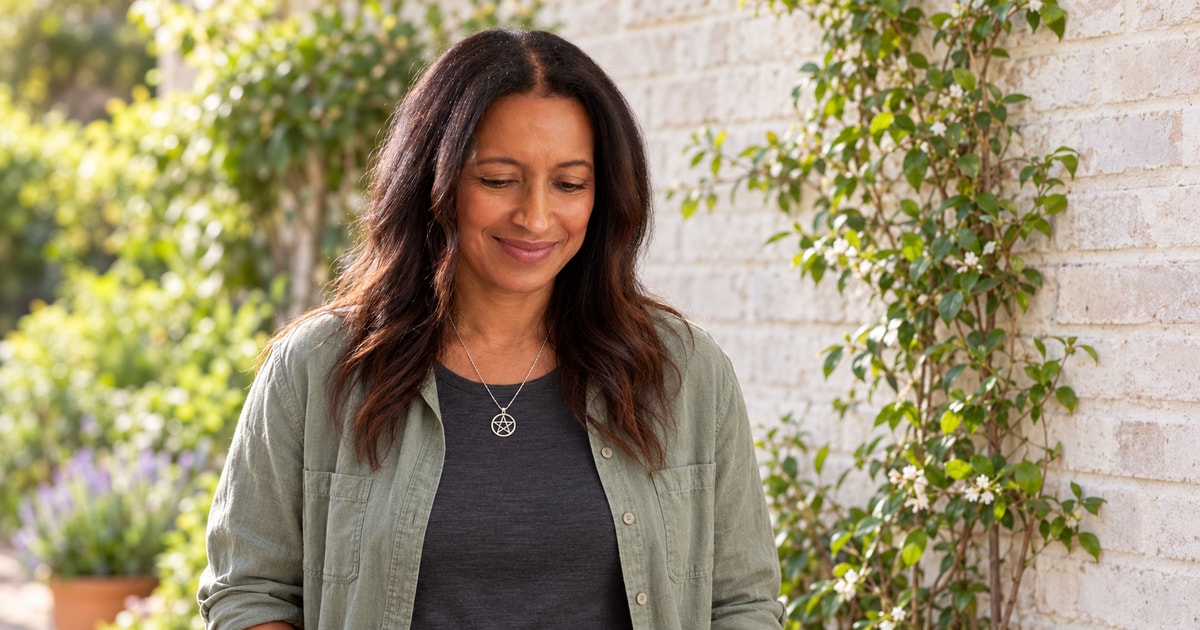
A pentacle can be a small piece of jewellery with a deeply personal meaning. You might wear it to express a spiritual path, remember an intention or feel connected to a community.
You do not need an expensive pendant or someone else’s approval to consider what the symbol means to you. Begin with the tradition you follow and the way you actually want to use it.
What do pentacle and pentagram mean?
In everyday contemporary use, “pentagram” often refers to a five-pointed star, while “pentacle” often describes that star within a circle or a physical object bearing the symbol. Usage is not perfectly uniform across historical texts and present-day communities.
Do not assume that every star-shaped object expresses the same belief. Ask the wearer or consult the particular tradition rather than assigning them an identity from the shape alone.
Make room for the meaning of a faith symbol
For some Wiccans and other Pagan practitioners, the symbol expresses a relationship with the elements, spirit or the connectedness of life. A person may also understand it through the teachings of their own community.
Its place as a religious emblem is not merely an internet trend. The US Department of Veterans Affairs’ list of emblems of belief includes Wicca’s pentacle. That is a specific recognition in the context of government headstones and markers, not a general ruling about every use of the symbol.
You can respect another person’s faith without claiming that their interpretation must be identical to yours.
Learn from actual objects, not an invented single origin
Stories about the pentacle sometimes combine different periods, symbols and traditions into one uninterrupted history. It is more useful to ask what a particular object was and who used it.
For example, the Museum of Witchcraft and Magic catalogues a copper pentacle associated with Stewart Farrar, with several Alexandrian symbols. Its collection also includes jewellery and objects made from different materials.
A museum record can document an object without proving every spiritual claim attached to the design. You do not have to invent an ancient pedigree for a symbol to matter in your life now.
Choose a way of wearing it that feels like yours
- Personal reminder: let the pendant call to mind a value such as care, balance or responsibility.
- Community connection: learn how the symbol is understood within a community you participate in.
- Private practice: wear it beneath clothing or keep it in a personal reflection space if that suits you.
- Conversation: share a short explanation when you want to—not because you owe strangers a spiritual biography.
You can also choose not to wear one. Jewellery is not a test of commitment or an entry requirement for spiritual exploration.
What about blessing or consecration?
If your practice includes a blessing, it can be a voluntary way to mark the object’s significance. You might use a few words of intention or ask a trusted member of your community about its customs.
You do not need fire, smoke, salt or water to make a personal statement of meaning. Keep the material’s care instructions and your surroundings in mind rather than damaging an object to complete an online ritual.
Spiritual protection can be meaningful as a belief or intention; a pendant is not a guaranteed physical safety measure. If you face an actual threat, seek appropriate practical support. Pressure to buy escalating “protection” services is not a requirement of wearing the symbol.
When someone misunderstands it
If you want to explain, try: “This is a symbol connected with my spiritual practice.” You do not have to debate or accept insulting assumptions.
Consider the circumstances and your comfort before deciding how much to share. A general article cannot determine a workplace, school or other legal right; seek relevant local advice if an actual dispute arises.
The most useful question may be simple: does wearing it support the way you want to live and relate to others?
The explanation of how a pentacle can aid in spell casting was quite detailed. It’s always interesting to learn about the various tools and symbols in different spiritual practices.
The piece offers a clear and respectful explanation of the pentacle. It’s important to dispel misconceptions and provide accurate information.
The article presents the pentacle in a balanced and informative manner. It’s clear that the symbol has deep significance for those who use it.
The article does a good job of explaining the symbolism behind the pentacle. It’s interesting to see how each element is represented.
I agree. The connection to the natural elements adds a meaningful layer to the symbol.
The idea that a pentacle can act as a talisman and enhance inner power is fascinating. It’s a perspective I hadn’t considered before.
Indeed, it’s intriguing to learn about the personal and spiritual dimensions attributed to the pentacle.
I found the section on how the material of the pentacle influences its spiritual properties particularly intriguing. The distinctions between wood, gold, and silver were well explained.
The article provides a well-rounded view of the pentacle’s significance. It’s a good resource for those looking to understand its role in earth-based spirituality.
I was unaware that the pentacle is also used for protection during spell casting. The explanation was enlightening.