

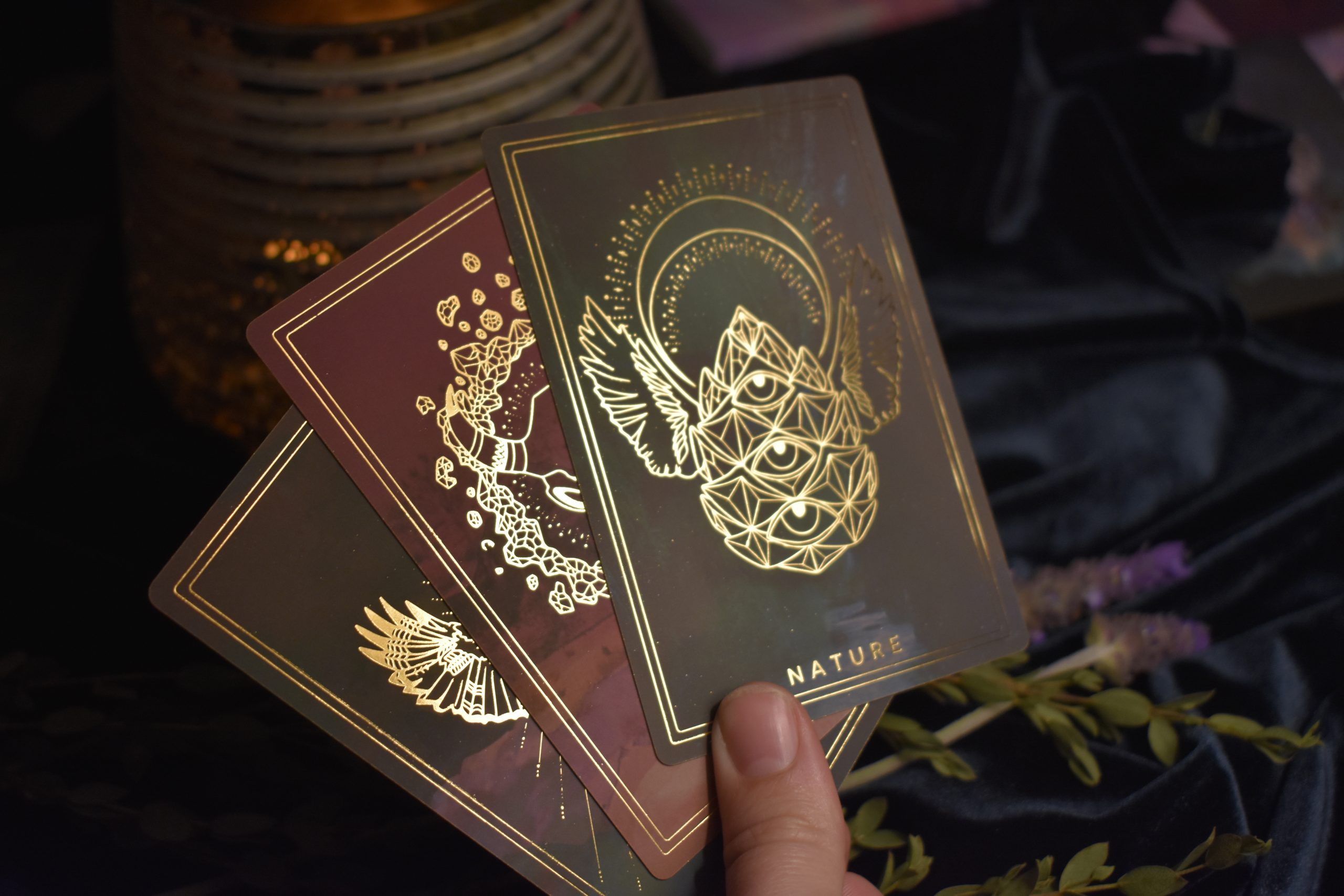
A handmade oracle deck can give your spiritual practice a language that feels like your own. A doorway, a seed, a favourite colour or a word such as “pause” can become a card you return to when you want a fresh perspective.
You do not have to be an experienced artist or make a large deck. Start small, keep the cards easy to handle and allow the meanings to develop as you use them.
Oracle cards do not need a tarot structure
A standard tarot deck has 78 cards arranged into Major and Minor Arcana. Oracle decks vary in size, theme and organization. Either type can be used for a single-card reflection or a larger spread; tarot does not require a multi-card layout.
Your own deck might have twelve cards about seasons of growth or twenty cards drawn from places that feel meaningful to you. Those are creative options, not required spiritual numbers.
1. Choose a theme with room to grow
Try a theme you can describe in one sentence: “gentle reminders for busy days,” “symbols from my garden” or “questions for a new beginning.” Make a rough list before decorating anything.
Include a range of experiences rather than only upbeat messages. Rest, patience, uncertainty and boundaries can be as useful as courage and joy. The deck does not need frightening cards to feel profound.
2. Use simple, matching materials
Blank index cards or smooth card stock are a practical start. Choose one size, trim carefully if needed and keep the backs similar so they do not reveal which card you are drawing. Pens, coloured pencils and your own small drawings are enough.
Avoid bulky decorations that make the deck hard to shuffle. Let any glue or finish dry fully according to its instructions before stacking the cards. You can skip coatings altogether and store the deck in a small box.
Use your own artwork and words, or images you have permission to use for your intended project. If you plan to sell or distribute the deck, check the terms for every borrowed asset before including it.
3. Give each card a clear starting meaning
A useful card can have a short title, a simple image and one question. Keep a separate notebook with a little more detail so the card face does not become crowded.
| Card idea | Image | A question |
|---|---|---|
| Threshold | An open doorway | What am I ready to begin, and what do I need first? |
| Roots | A small plant | What supports me when life feels changeable? |
| Pause | An empty chair | Where could a little space help me respond more thoughtfully? |
| Voice | A speech bubble or songbird | What would I like to say honestly and kindly? |
| Companion | Two paths meeting | Who could offer company or practical support? |
4. Test a small first edition
Make six to twelve cards before committing to a large set. Draw one and notice whether its question opens a useful reflection. Does the wording make sense a week later? Are two cards doing almost the same job?
You may change a title, redraw an image or add a missing theme. Revision is part of making the deck yours, not evidence that its energy was wrong.
5. Create a short reading ritual
Hold the deck, choose an intention and shuffle in a comfortable way. Draw one card and write a response to its question. If you prefer three cards, try “what I notice,” “what I can explore” and “a small next step.”
Use the cards to reflect on your own experience rather than to diagnose symptoms, establish another person’s private feelings or make a decision for them. A card can suggest a question without becoming an order.
Store the deck as something you made with care
A box, pouch or paper band can protect it from bent corners and spills. Add a note naming the theme and the date you began. There is no requirement to buy an activation, cleanse it repeatedly or keep it away from every person who does not share your beliefs.
The finished deck does not have to look professionally printed to hold personal meaning. Its strength is the thoughtful relationship between your symbols, your questions and your life.
I appreciate the detailed guidance on how to create your own Oracle deck. It’s inspiring and makes the process seem accessible.
Using household items to create Oracle cards is a great way to start without needing to purchase additional supplies.
This article provides a clear differentiation between Oracle and Tarot cards. It’s useful for beginners trying to understand the basics.
The idea of using your intuition to create a deck is appealing. It makes the deck more personal and meaningful.
It’s helpful that the article mentions the use of different art media like watercolors and spray paints. It provides flexibility in design.
I find the comparison between Oracle and Tarot cards particularly interesting. They indeed serve different purposes in divination.
The discussion on themes is very thorough. It’s important to choose a theme that resonates personally.
The suggestions for materials are quite comprehensive. It’s nice to see there are so many options available.
Yes, it opens up a lot of creative possibilities!
Agreed. It makes the process less daunting and more fun knowing you can use everyday items.