

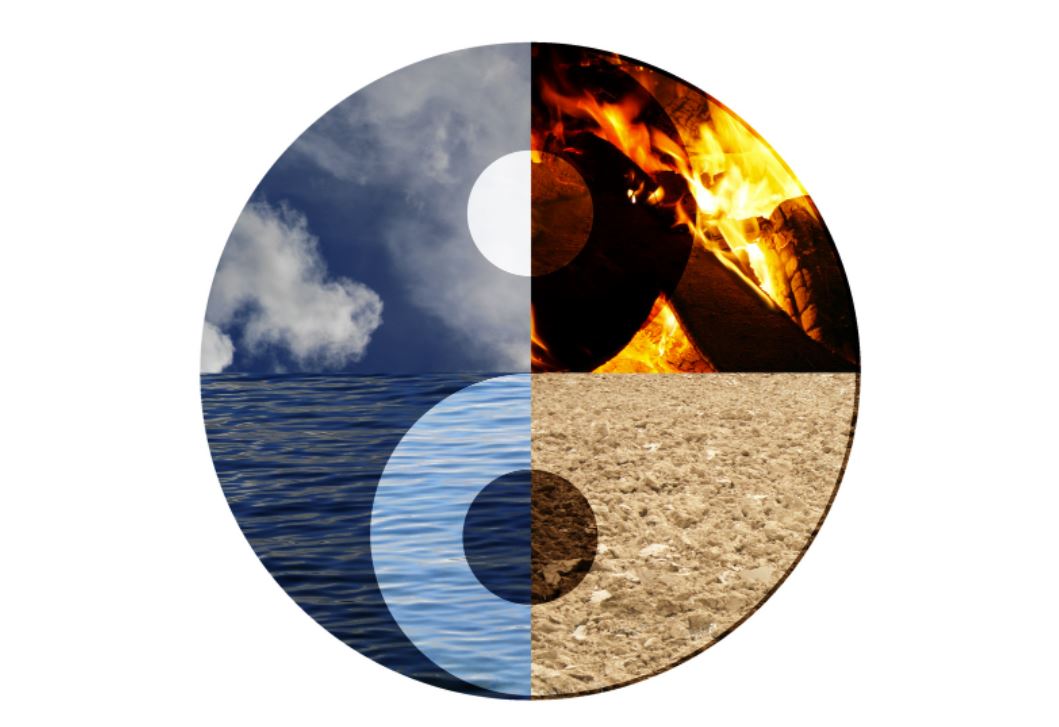
Learning the four elements gives you a useful way into the Minor Arcana. Instead of memorizing every card in isolation, you can notice the kind of experience a suit often brings into a reading: feelings, inspiration, practical life or thought.
The associations below are common in modern tarot practice. Deck traditions can differ, so let your own guidebook and the card’s imagery have a voice too.
| Element | Usual suit | Themes to explore |
|---|---|---|
| Water | Cups | Feelings, relationships, imagination and receptivity |
| Fire | Wands | Initiative, desire, creativity and momentum |
| Earth | Pentacles or Coins | Resources, work, the body and everyday foundations |
| Air | Swords | Thought, communication, discernment and conflict |
Water and Cups: listen to the feeling
Water offers an image of movement, depth and changing emotional currents. Cups often draw attention to how you relate: what you give, receive, remember or long for.
For the Two of Cups, you might explore reciprocity. For the Four of Cups, you might notice withdrawal, dissatisfaction or an invitation you have not considered. Neither card tells you exactly what someone else feels.
Ask, “What am I feeling, and what would help me express it honestly?” Feeling deeply and thinking carefully are not opposites.
Fire and Wands: give inspiration a direction
Fire can symbolize the spark that gets something started. Wands often concern enthusiasm, ambition, creative energy and the effort of sustaining a project.
The Ace of Wands may invite you to notice an idea worth trying. The Ten of Wands may prompt a look at the weight you are carrying. A suit is not simply positive or negative; the question is how its quality is working in the situation.
Ask, “What am I ready to begin, and what pace can I sustain?”
Earth and Pentacles: attend to what supports you
Earth brings the reading toward tangible life: time, work, money, routines and the things you maintain. Pentacles can invite patience and attention to the conditions that allow something to grow.
The Eight of Pentacles may suggest practice or craftsmanship. The Four of Pentacles may raise questions about security, holding on or having enough. A money-related image is not a promise of wealth or a substitute for checking actual costs.
Ask, “What practical resource or habit would make the next step possible?”
Air and Swords: find the words and the distinction
Air is often connected with ideas, language and the way you understand a situation. Swords may invite clarity, reveal a disagreement or ask you to distinguish a fact from an assumption.
The Ace of Swords might suggest a new way of naming an issue. The Two of Swords might invite a pause to identify the choice in front of you. Difficult imagery does not mean the suit is bad or that trouble must follow.
Ask, “What needs to be said, clarified or reconsidered?”
Notice the balance in a spread
Several Cups may make an emotional theme worth exploring; several Pentacles may bring practical conditions forward. An absent suit can become a question, but not a diagnosis of something missing from your personality.
If a spread is full of Wands, for example, you might ask where to direct your enthusiasm and then bring in an earth question: “What time or support will this take?” You do not need to draw extra cards to force every element into the reading.
Use the elements without gender rules
Some older esoteric descriptions call elements masculine or feminine. You do not have to turn that vocabulary into rules about people’s gender, abilities or roles. Everyone can express care, courage, practicality and clear thought.
A simple learning exercise
- Choose one Minor Arcana card.
- Name the suit and its usual element.
- Describe what is happening in the picture.
- Write one question combining the image and the element.
- Check your guidebook and keep what adds useful context.
Let the elements be a doorway into the card, not a replacement for looking at it.
The explanation of the elements and their relation to tarot cards is quite informative. It helps in understanding the underlying principles of tarot readings.
The detailed insights on each element’s characteristics and their impact on readings are useful for both novices and experienced readers.
Understanding the elements and their corresponding suits can improve the accuracy and depth of tarot readings. It provides a structured approach.
While the article provides a thorough overview of the elements and their significance, one might wonder how these interpretations align with traditional and modern tarot practices.
That’s a valid point. Comparing these interpretations with various tarot traditions could further enhance understanding.
The connection between numerology and the elements in tarot is fascinating. It shows how interconnected different esoteric practices can be.
The suggestion to connect with the elements physically, like going to the ocean, is a practical tip for deepening one’s understanding and experience of the elements.
Indeed, experiencing the elements firsthand can provide intuitive insights that enhance tarot readings.
Practical engagement with the elements can help solidify theoretical knowledge in a tangible way.
I appreciate the balance of positive and negative aspects for each suit. It highlights that tarot readings can reflect both strengths and weaknesses.
The use of elements to describe the Minor Arcana suits adds a layer of depth to tarot reading. It can be an interesting way to connect with the cards.