

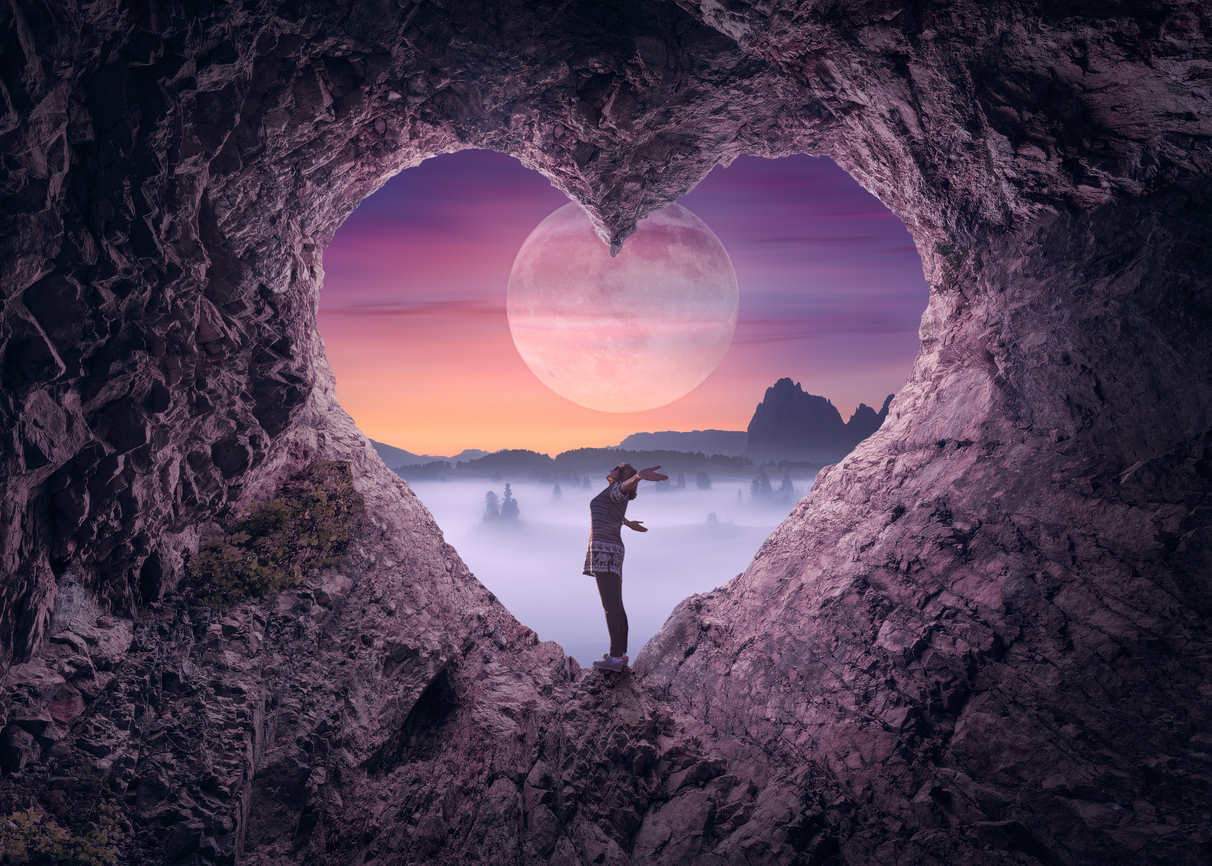
The changing Moon can offer a beautiful rhythm for a love journal, a quiet ritual or a shared check-in. You may connect its phases with beginnings, growth, illumination and release.
Use that symbolism as an invitation, not a timetable that decides whether love will arrive or a relationship will last. A meaningful lunar practice can leave room for ordinary conversation and both people’s choices.
Know the phase you are observing
NASA’s Moon-phase guide describes eight phases in a cycle of about 29.5 days. The changing appearance comes from how much of the Moon’s sunlit half we see as it orbits Earth.
That astronomical cycle is different from the meanings used in spiritual practice. The prompts below are a suggested contemporary reflection routine, not a claim that everyone shares one lunar tradition.
Eight phases, eight questions
| Moon phase | A reflection theme | A question for your journal |
|---|---|---|
| New moon | Name an intention | What would I like more of in the way I connect? |
| Waxing crescent | Begin gently | What small invitation or honest action is available? |
| First quarter | Choose a workable step | Which decision needs a conversation rather than another guess? |
| Waxing gibbous | Adjust with care | What is working, and what could we change? |
| Full moon | Notice what is present | What can I appreciate, and what needs to be acknowledged? |
| Waning gibbous | Reflect and share | What have I learned that I can express kindly? |
| Last quarter | Review what to carry | Which expectation or arrangement no longer fits? |
| Waning crescent | Make room for rest | What can wait while I look after myself? |
If you are single
You might begin with an intention about the kind of connection you want: honesty, affection, mutual curiosity or a pace that feels comfortable. Choose an action that belongs to you rather than an exact date by which someone must appear.
For example, you could accept an invitation you genuinely want, make your preferences clearer or decide to take a break from dating. A quieter month is not evidence that you missed the Moon’s opportunity.
If you are in a relationship
Ask whether your partner would enjoy a lunar check-in. They do not need to share every spiritual interpretation to participate in a conversation, but participation should be welcome rather than a test of commitment.
Choose one appreciation and one practical question. Perhaps you want more unhurried time together, a clearer plan or a change in how cancelled plans are handled. Keep the request specific enough for both people to understand.
If you are grieving an ending
A waning-Moon ritual may feel fitting for release, but you do not have to stop missing someone before the next new moon. Feelings need not follow the calendar.
You could write what you want to carry forward and what contact boundary would support you now. Do not use a new cycle as a reason to ignore an ex’s request for distance or expect a promised reunion.
A simple ritual without extra purchases
- Check the phase using a reliable lunar calendar.
- Choose one question from the table, or write your own.
- Take a few comfortable minutes to reflect, pray or draw a card if you wish.
- Write one action that is within your control.
- Revisit it when useful, without forcing a result by the next phase.
You can do this indoors, during the day or without seeing the Moon. You do not need to stay awake late, leave home at an unsafe time or buy a special kit.
Let the relationship remain more than a symbol
A phase on the night you met can become part of your story. It is not a compatibility result or proof that the connection must continue. What you agree to and how you treat each other still matter.
Likewise, do not postpone an important conversation or necessary support until the sky seems more favourable. Let the Moon mark a moment of attention while your choices stay your own.
The concept of moon phases impacting relationships seems to intersect with astrological beliefs. It would be interesting to see if there is any scientific basis to support these claims.
Astrology has been around for centuries, but it is always valuable to have research to back up these kinds of assertions.
I agree. It would be beneficial to see some empirical data or case studies that substantiate these ideas.
Overall, the article offers a unique take on how lunar phases could potentially influence the dynamics of personal relationships. It’s certainly food for thought.
The idea of the moon influencing our emotions and relationships aligns with many cultural and historical beliefs about lunar cycles.
The breakdown of each moon phase and its potential impact on relationships is detailed and thought-provoking.
Indeed, the specific attributes assigned to each moon phase add depth to the discussion about personal and relational growth.
I’m curious how one could practically apply this information in daily life. Does charting moon phases really offer tangible benefits?
The emphasis on understanding and harnessing energies during different moon phases can be a useful tool for those interested in astrology.
The article provides an interesting perspective on the influence of moon phases on relationships. It is intriguing to see how celestial events could potentially affect human behavior and emotions.
This perspective may provide an additional layer of understanding in the study of human relationships and emotional health.