

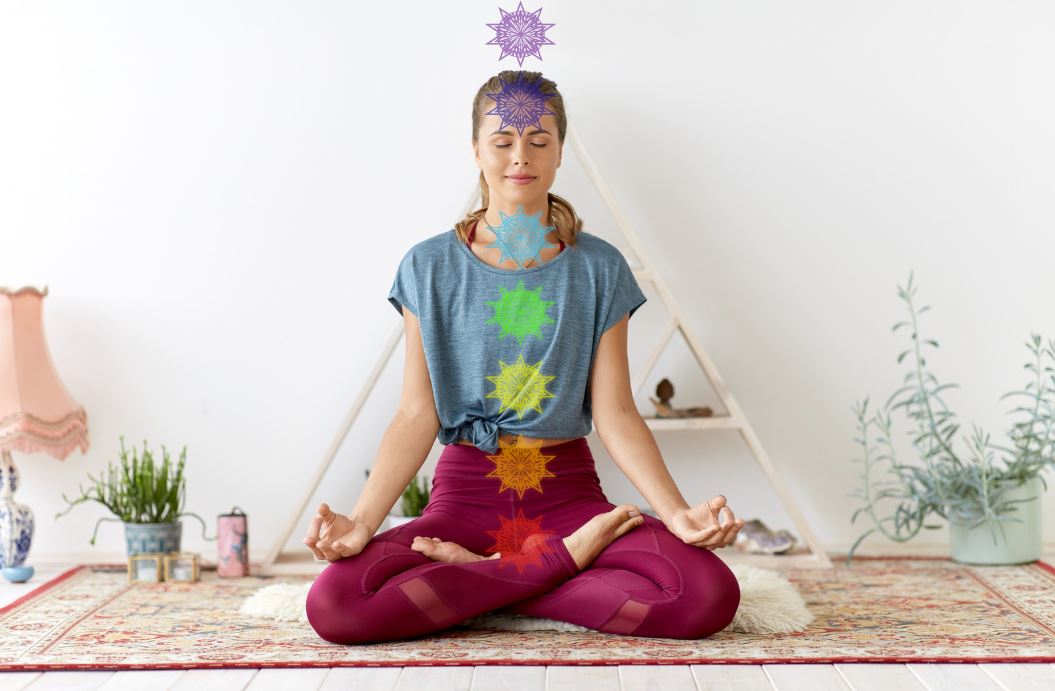
Chakra balancing does not have to mean working on every centre in one sitting. Sometimes the most useful practice is to notice what needs attention and choose one gentle way to respond.
If you understand chakras as subtle-energy centres, this can be part of that spiritual relationship. If you use the map mainly for reflection, the same questions can help you give a neglected part of life a little room.
Begin with the theme, not a diagnosis
The familiar seven-chakra map includes grounding, creativity, agency, compassion, expression, insight and connection. Our seven-chakra guide introduces the names and common associations.
Instead of searching a list of symptoms to decide which centre is blocked, ask, “What has been asking for my attention?” A spiritual interpretation does not establish the cause of pain, fatigue or an emotion. Keep health concerns with appropriate care.
Choose the kind of practice you need today
If you feel scattered: simplify
Try a grounding pause. Notice the surface beneath you, look around the room and choose one thing to do next. You may connect that with the root theme without needing a special object or a long session.
If life has become all duty: make a little creative room
The sacral theme can invite enjoyment without a productivity goal. Listen to a song, draw a simple shape or make something familiar. Choose an activity that fits your energy and circumstances.
If you keep agreeing too quickly: listen to your preference
Use the solar-plexus theme to ask what you actually want. “I need time to decide” may be a more useful balancing practice than trying to feel confident on command.
If you are overextended: combine kindness with a boundary
The heart and throat themes can work together. You can care about someone and still name what you cannot take on. Connection does not require unlimited availability.
If you are searching for certainty: allow a question
The third-eye and crown themes can invite perspective and meaning. Write what you know, what you believe and what remains uncertain. You do not need to resolve every spiritual question today.
Choose one theme for one ordinary moment
Suppose someone asks you to take on another task and you feel yourself about to agree. If the solar-plexus theme speaks to you, use it to notice your preference. You might say, “I need to look at my week. I’ll let you know tomorrow.”
When you have time to decide, ask what you can realistically offer. If your answer is no, you can borrow one of these short boundary scripts. Saying how much time you have can be part of the practice.
Later, notice whether the pause helped you answer more honestly. Choose another theme on a different day if it gives you a question you’d like to explore.
Use tools only when they add something
A colour, a crystal, a piece of music or a familiar prayer may help mark the practice. Choose it for personal meaning rather than a promise that the object will correct you. Silence, a notebook or a short walk can be enough.
If you use sound or scents in shared space, consider other people’s comfort. You can choose a quiet, fragrance-free version without making the practice less complete.
Let balance mean responsiveness
Balance need not mean equal time for every theme. A demanding week may call for more grounding; another may leave room for creativity. Paying attention to a real need is different from chasing a perfect spiritual score.
Try one small practice and notice whether it suited you. If it did not, change it. You do not need to repeat an exercise until a particular sensation appears or ask someone else to certify that your centres are balanced.
Close with a choice you can carry forward
Write, “The theme I chose was… The practice I tried was… The next step I want is…” Keep the answer manageable. A request for help, a clear conversation or a little rest may be a meaningful expression of the work.
You are allowed to be a person in changing circumstances, not a permanently balanced diagram.
Overall, this article provides a holistic view of chakra balancing. It would be even better with more references to scientific research and case studies.
I appreciate the clear descriptions of each chakra and the associated physical and emotional symptoms. This is helpful for anyone new to this concept.
The mind-body connection described here aligns with holistic approaches to health. It’s a reminder of how interconnected our physical and emotional states can be.
It’s important to address both aspects for true healing and balance.
Absolutely, recognizing this connection can greatly enhance our overall well-being.
The idea that balancing chakras can lead to a more peaceful and confident life is quite appealing. It encourages me to explore this further.
The correlation between chakra imbalances and physical ailments is quite compelling. I’d be curious to know if there are scientific studies that support these claims.
It would be interesting to see a blend of traditional knowledge and modern science in this area.
There are certainly studies on the benefits of meditation and mindfulness, but direct scientific evidence on chakras might be limited.
The practical tips for balancing chakras, like using massage, are useful. It makes the concept more accessible to a wider audience.
The use of crystals and essential oils for balancing chakras adds an intriguing element to the practice. It’s nice to see traditional methods being promoted.
While it’s traditional, I’m skeptical about the efficacy of crystals. More concrete evidence would be helpful.
Crystals and essential oils have been used for centuries, and many people find them beneficial. It might be worth trying for personal experience.
This article provides a detailed overview of the chakras and their impact on both physical and emotional well-being. It’s interesting to see the various methods for balancing them.