

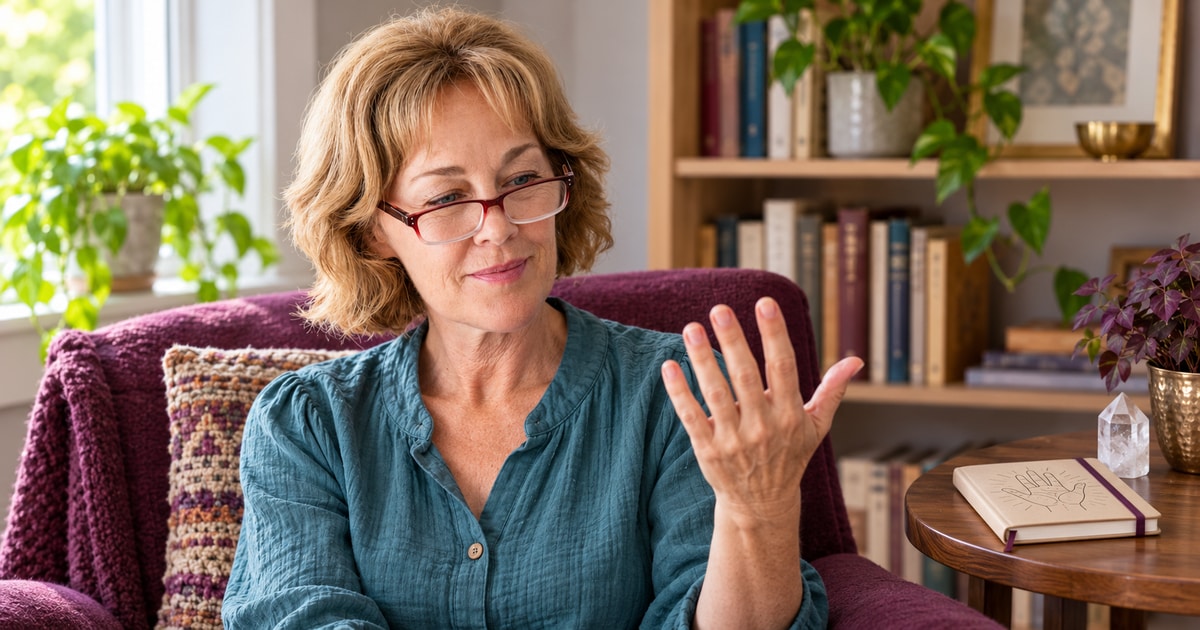
A short, faint or broken fate line is not a warning about your lifespan. If a palm reading has left you worried about death, take a breath: the lines on your hand cannot tell you when you will die.
You can still enjoy palmistry as a spiritual tradition. The fate line offers an interesting starting point for exploring direction, responsibility and the paths you feel drawn towards. It does not need a frightening prediction to make the conversation meaningful.
The reassuring answer first
- A short fate line does not mean a short life.
- A missing or faint fate line does not mean you lack purpose.
- Breaks and branches can be explored symbolically, not treated as scheduled events.
- A palm reading cannot diagnose illness or measure life expectancy.
Where is the fate line?
In many palmistry traditions, the fate line is a roughly vertical line that travels through the centre of the palm towards the middle finger. You may also hear it called the Saturn line or destiny line. Its starting point, length and visibility vary from hand to hand.
Not everyone has one strong, continuous line. You might see several light sections, a branching line or no obvious line at all. There is no need to draw a dramatic conclusion from an ordinary difference between hands.
If you are new to the subject, our simple guide to palm reading introduces the main lines, shapes and mounts before you focus on one feature.
What the fate line traditionally symbolizes
Readers often connect this line with a sense of direction: work, commitments, responsibilities or the circumstances that shape a person’s path. These are interpretive themes, not fixed facts about what your future must contain. Different readers may understand the same marking differently.
Direction
What gives your days a sense of purpose? A career may be part of that answer, but caring, creativity and community can matter just as much.
Transitions
Where have your priorities changed? A symbolic reading can help you put words to a turning point you already recognize.
Your influence
Which parts of your next step are yours to choose? Keep the reading connected to your actual options rather than a fixed destiny.
A short, broken or absent line: what can you take from it?
A palmist may describe a short line as emphasis on one period of responsibility, a break as a change of course, or a branch as competing interests. Another reader may offer a different explanation. None of these markings proves that you will lose a job, become ill or experience a particular event.
A more helpful question is, “Does this theme connect with something I am living through?” If the suggestion fits, use it to reflect. If it does not, you are allowed to leave it there. You do not have to reshape your story to make every interpretation work.
For example, a discussion of a broken line might lead you to think about returning to study after years of caring for family. The useful part is the conversation about your goals—not a claim that the break caused that transition.
The fate line and life line are not the same
The life line is the curved crease around the base of the thumb; the fate line is usually more central and vertical. In traditional readings they carry different associations. Neither is a clock counting down the years of your life.
It is especially unhelpful to turn the word “life” into a promise about longevity. A long line is not a guarantee of a long life, and a short line is not a reason to expect an early death. Your future is not made safer by repeatedly checking a photograph of your palm.
Why a palm reading is not a health check
Earlier versions of this article suggested that fate-line markings could reveal disease or mental illness. That is not a sound basis for a health conclusion. We have removed those claims. A change in a symbolic interpretation is not a diagnosis, recovery measure or reason to stop care.
Medical professionals may examine hands as one part of an assessment, but that is different from fortune-telling. MedlinePlus explains that even a single palmar crease can be a normal variation and is considered alongside other findings. One feature should not be turned into a story about your entire health.
If you have pain or a physical change that concerns you, seek appropriate care rather than asking a reader to interpret it. The NHS guide to palm pain explains when to get medical help. Spiritual reflection and looking after your health can sit comfortably alongside each other.
What to do if a reading has frightened you
A confident prediction can stay in your mind even when it has no reliable basis. Start by separating the statement from the evidence: a reader said something alarming, but saying it does not make it true. You do not need another paid session to cancel the prediction.
- Pause the reading. You can say, “I do not want death or health predictions. Please stay with the topic I asked about.”
- Keep the wording. If you need to raise a concern with a service, an exact note is more useful than trying to remember the conversation later.
- Step away from repeated checking. Give yourself some distance from searching palm photographs or asking several readers to reassure you.
- Choose a grounded source of support. Talk with someone you trust. If the fear is interfering with everyday life, a qualified mental-health professional can help you work through it.
If someone asks for money to remove a curse, extend your life or prevent a predicted death, do not treat that payment as necessary protection. Our guide to psychic scam warning signs can help you recognize pressure without dismissing the spiritual practices you value.
Questions that make a fate-line reading more useful
You can guide the session towards possibility rather than fear. Ask, “What themes do you associate with this line?” followed by, “How else might you read it?” A reader should be able to explain an interpretation without insisting that you must accept it.
Try a question tied to your life now: “What might help me reflect on my next career chapter?” or “How can I understand the responsibilities I keep returning to?” Afterwards, write down one idea you want to explore and one small, realistic next step.
The best takeaway is not a deadline attached to a hand line. It is a clearer sense of what matters to you, what you can choose and where you want to place your attention.
Fate-line questions, answered
1. Can the fate line predict when I will die?
No. The length, depth or ending of a fate line cannot establish a date of death. A palmistry reading is not a lifespan assessment.
2. Does a short fate line mean a short life?
No. A short fate line is not a measure of life expectancy. In symbolic readings, some palmists relate it to a particular phase of work or responsibility instead.
3. What if I cannot find a fate line?
You may have no obvious central vertical line, or several faint sections. That does not mean you have no purpose, no future or bad luck. You can explore other features without forcing a line to appear.
4. Is the fate line the same as the life line?
No. The fate line usually runs up the central palm towards the middle finger. The life line curves around the base of the thumb. Neither gives a reliable lifespan measurement.
5. What does a broken fate line mean in palmistry?
Some readers interpret a break as a change in direction, work or responsibility. Interpretations vary, and a break is not proof that a particular event will happen.
6. Can a palm reader diagnose an illness?
A symbolic palm reading cannot diagnose illness or mental-health conditions. Health concerns need an appropriate clinical assessment, not a prediction based on line patterns.
7. Which hand should I look at?
Different palmistry traditions use different approaches. Some compare the dominant hand with the other hand to discuss current patterns and potential. Ask your reader which approach they use rather than assuming one universal rule.
8. Does a deep fate line guarantee success?
No. Some palmists associate a clear line with sustained focus, but it does not guarantee wealth, status or a particular career outcome. Skills, circumstances and choices still matter.
9. Can a faint line become clearer?
The appearance of your hands can vary, including with lighting and skin condition. A clearer-looking line is not a medical result or proof that destiny has changed.
10. Should I compare my palm with an online photograph?
You can use a guide to learn the vocabulary, but angle, lighting and natural differences can make comparisons misleading. Use photographs for orientation, not for alarming conclusions about your life.
11. What should I ask during a fate-line reading?
Try asking what themes the reader associates with the line, how those themes relate to your question and what alternative interpretations are possible. You can exclude death and health predictions from the session.
12. What if a reader gives me a frightening death prediction?
You do not have to accept it as true. End or pause the conversation, keep a record of what was said and avoid paying for a promised removal of danger. Talk with someone you trust if the message stays with you.
13. Can I enjoy palmistry while questioning an interpretation?
Yes. You can value the symbolism, ritual or conversation without agreeing with every statement. A useful reading leaves room for your questions and your own understanding of your life.
14. Do I need a long fate line to have a spiritual purpose?
No. A hand feature does not determine your worth or spiritual purpose. Reflect on what you value, the people you care for and the choices that make your life feel meaningful.
15. How can I reflect on a reading afterwards?
Write down one theme that resonated, one question it raised and one small action you want to consider. Give yourself time before making a significant decision.
This article provides an intriguing insight into palmistry and its limitations in predicting one’s death.
Interesting to note the article’s point that health and lifestyle choices have a significant impact on our lives.
Yes, taking care of one’s health can make a substantial difference in life expectancy.
Agreed, maintaining good habits is always beneficial regardless of what any reading suggests.
It’s crucial to approach palm reading with a critical mind and not take it as a definitive science.
Absolutely, it should be seen more as a form of insight rather than predictive accuracy.
It’s fascinating how the fate line is interpreted differently by various palm readers.
Indeed, interpretations can vary widely, which makes it a more subjective practice.
The explanation about the fate line and its relation to health rather than death is quite clarifying.
The advice to live the healthiest life possible and not dwell on predicting death is a practical takeaway from this article.
Learning about how other lines on the palm, like the heart and head lines, can offer more comprehensive readings was enlightening.
While palm reading can be interesting, it’s important to remember that it can’t determine exact outcomes like death.