

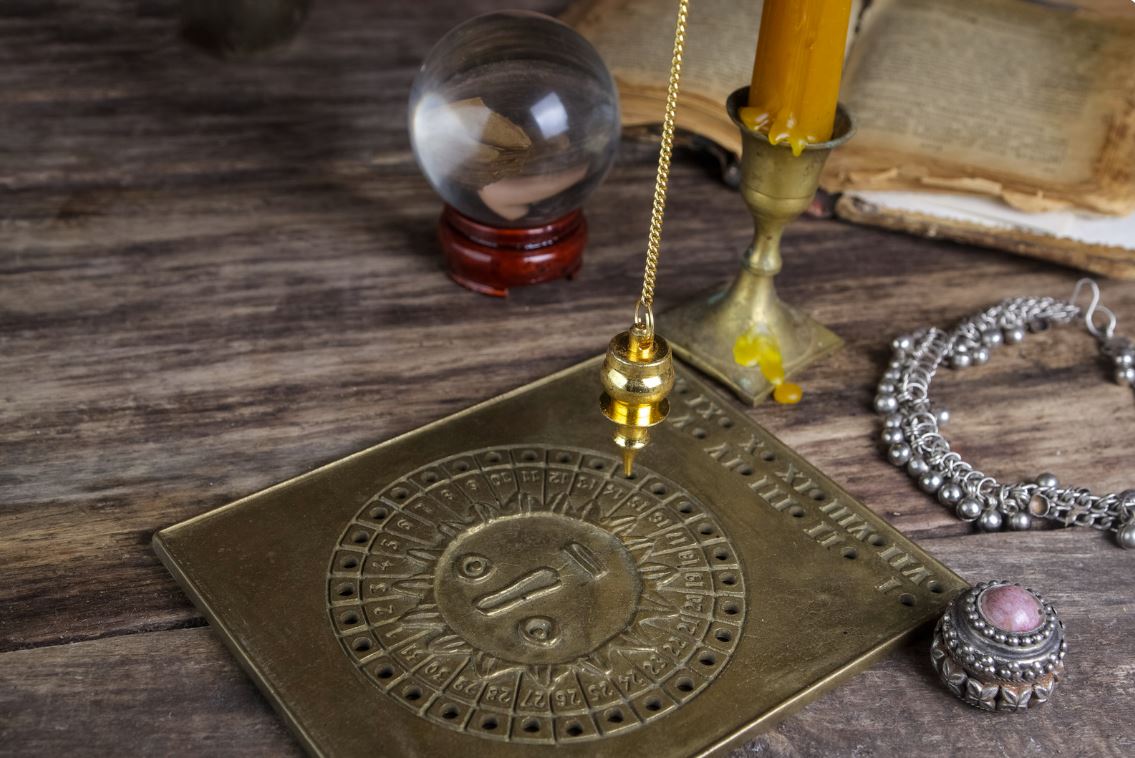
A pendulum can give a quiet spiritual practice a visible focus. Some people use it while reflecting on their connection with guides; others use the movement to notice their own preferences or questions.
However you understand the ritual, a swinging pendulum does not independently verify a spirit’s identity or establish an answer about health, another person’s feelings or the future. You can explore the experience without handing it authority over your life.
What makes a pendulum move?
A small weight on a chain amplifies tiny movements of the hand holding it. Those movements can happen without a deliberate decision to move, and expectations can affect them. This is commonly described as the ideomotor effect.
The physical movement and your spiritual interpretation are different questions. Feeling that a swing is meaningful does not make it an independent measurement. You do not need to dismiss your beliefs to account for how the object is being moved.
Begin with a short, low-pressure session
- Sit comfortably with your arm supported and the pendulum clear of the surface.
- Choose a simple intention, such as approaching the practice with curiosity.
- Notice the movement without trying to force it.
- If you use yes-and-no directions, write down your convention.
- Keep the session brief and finish without repeatedly checking the same question.
No movement, a changing direction or an unclear swing is not evidence that a hostile presence is interfering. You can stop, rest or decide that the tool is not useful for you.
Ask a question that opens reflection
Rather than “Will this person come back?” try asking yourself, “What do I hope the answer will be, and why?” You can notice your response before drawing any conclusion from a swing.
If you work with guide imagery, a gentler prompt is, “What quality of support would I like to invite?” Write about patience, courage or kindness. Treat a name or image that arises as part of the experience, not a verified identity or an instruction you must obey.
Keep important decisions outside the yes-or-no code
A pendulum should not decide medication, diagnose an illness, select an investment, accuse someone of dishonesty or determine whether another person consents. Those questions need information the pendulum does not independently supply.
For an ordinary personal choice, use the session as one reflection among others. Write the options, consider the consequences and take time. If you only accept the swing you wanted, notice that preference directly rather than asking again until it appears.
Do you need cleansing or an activation?
You may enjoy a prayer or a quiet ritual before using a tool. It is optional. A pendulum does not require an expensive stone, an activation fee or a paid removal of supposed attachments to become physically capable of swinging.
Do not let someone turn uncertainty into fear or ongoing payments. You are free to put the tool away, change your practice or leave it behind without completing a special closing purchase.
Review the experience in your own words
Record the question, your expectations, the movement and what you took from it. Keep “what I felt” separate from “what I can confirm.” If the practice becomes frightening, compulsive or disruptive, pause it and reach out for support.
A spiritual tool can be part of a meaningful ritual while your judgment, privacy and choices remain your own.
It is important to maintain an open but critical stance when exploring such spiritual practices. Personal discernment and mindfulness are key.
The steps to communicate with guides using a pendulum are quite detailed. It would be interesting to hear personal experiences from those who have successfully tried this.
The process of using a pendulum for spiritual communication is very structured. I’d be interested in knowing if there are any scientific studies on the reliability of this method.
Pendulums as a means of communication with guides seem to be rooted in spiritual beliefs. It might not resonate with everyone, but it provides a structured approach for those who are interested.
I agree, the approach is well laid out, but it would be beneficial to also consider alternative methods and perspectives.
The concept of using pendulums to connect with spiritual guides is intriguing. I wonder if there is any empirical evidence supporting the effectiveness of this method.
This article touches on the broader theme of seeking guidance from external sources. It’s fascinating to consider the psychological implications of such practices.
While this article provides detailed instructions, it is important to approach such practices with caution and a critical mindset.
This detailed guide on using pendulums to connect with guides offers a unique perspective on spiritual practices. It’s an insightful read for anyone exploring this area.