

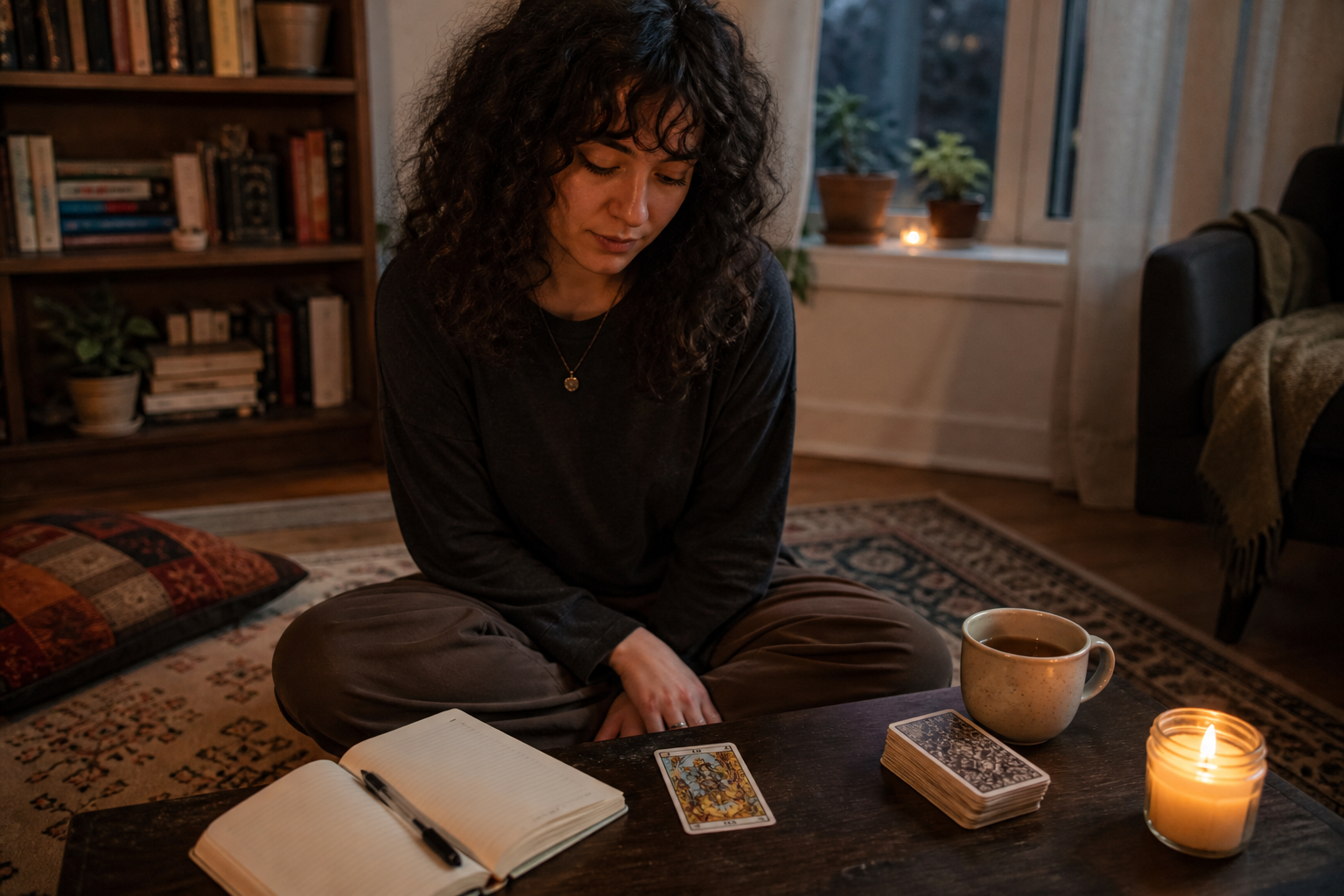
One card can give your day a thoughtful beginning. A short tarot practice offers an image to notice, a spiritual theme to explore and a question you can carry into ordinary life.
You do not need to know every card before you start. This simple method leaves room for intuition, a guidebook and your own experience, without asking the card to decide your day for you.
Choose a deck you want to spend time with
Look at sample cards if you can. Do you enjoy the artwork? Are the names and details readable? Is the size comfortable for your hands? A clear guidebook can be especially helpful when you are learning.
A deck with illustrated scenes on the numbered cards may give you more visual details to explore. Other traditions use different designs, so choose the learning approach you enjoy. You can buy your own deck; it does not have to arrive as a gift.
The five-minute method
- Settle. Choose a comfortable place and a brief intention. A prayer or quiet pause is optional.
- Ask. Try, “What deserves my attention today?” or “What quality could support me?”
- Shuffle and draw. Use a method that suits your hands. One card is enough.
- Look. Notice an expression, object, colour or movement in the image before reading a meaning.
- Connect. Check the guidebook if you want, then write one thought and one manageable intention.
Five minutes is a useful shape, not a rule. You can take less time, pause midway or decide that today is better suited to a quiet moment without cards.
Let the image and the meaning work together
Your first response can be interesting without being the only valid interpretation. A traditional meaning may add context; a detail in your particular deck may suggest another question. You are learning a symbolic language, not taking a test with one answer.
For a simple starting point, the prompts below use familiar contemporary associations. Read them alongside your own deck rather than treating the table as a complete dictionary.
| Card | A theme to explore | A daily question |
|---|---|---|
| The Fool | Openness and a beginning | What small step could I try without needing perfection? |
| The Magician | Initiative and resources | What do I already have that could help? |
| The High Priestess | Inner listening and uncertainty | What might become clearer if I make a little space? |
| The Empress | Care and growth | What would thoughtful care look like today? |
| Strength | Gentle courage | Where can I be steady without being harsh? |
| The Star | Hope and renewal | What small source of hope can I notice? |
| Death | Release and transition | What am I ready to let change? |
| The Tower | Disruption or a revised perspective | Which assumption deserves another look? |
If the card unsettles you
A difficult image does not need a literal interpretation. Death is not a forecast that someone will die; the Tower is not a requirement to expect disaster. Explore the theme gently, close the reading or put the deck away.
You do not have to draw again until you find a comforting card. If the practice begins to feel like constant checking, take a break and choose a different kind of reflection.
Keep a simple learning note
Write the date, card and a few words about what you noticed. Add what you chose to do with the idea. Over time, you can see which interpretations were useful and which did not fit.
If you want to carry the card into a later reflection, our morning-to-evening card-of-the-day guide offers a short journal format. You do not need to analyse the whole day after every pull.
Bring relationship questions back to your choices
“How can I communicate more clearly?” leaves you something to consider. “What is my partner secretly thinking?” asks the card to establish information it cannot independently verify. Respect other people’s privacy and let real conversations matter.
Keep health, safety and other important practical decisions with appropriate information and support. A meaningful card can accompany reflection without replacing those checks.
Questions about a daily tarot practice
1. What do I need for a daily tarot reading?
A deck and a few comfortable minutes are enough. A notebook is useful but optional; you do not need a special room, cloth or purchase.
2. Must I pull a card every day?
No. A flexible practice is fine. Missing a day or taking a break does not harm the deck or invalidate your next reading.
3. Is morning better than evening?
Choose the time that suits your life. A morning pull can set an intention; an evening pull can invite reflection.
4. How should I shuffle?
Use a method that is comfortable for your hands and deck. You can shuffle, mix cards on a clear surface or use another practical method.
5. Where should I draw the card from?
You may draw from the top, choose from a fan or use another consistent method. There is no universal rule you must follow.
6. Do I need to read reversed cards?
No. Some readers use reversals and others do not. Choose an approach, learn it and allow yourself to change it later.
7. Can I use the guidebook?
Yes. A guidebook can help you learn a deck’s symbolism. Reading it does not make your intuition less valid.
8. What makes a useful daily question?
An open question about your own attention or choices, such as “What quality would support me today?” leaves room for reflection.
9. What if I draw Death?
Explore themes such as release, transition or an ending. A daily card is not a death prediction or a reason to fear for someone’s safety.
10. What if I draw the Tower?
Consider a perspective that needs revising or a change you are already navigating. You do not need to expect a disaster.
11. Should I draw another card if I dislike the first?
You may choose to stop or reflect without cards. Repeated draws to obtain reassurance can make the practice feel less helpful.
12. Can a card tell me what my partner feels?
Do not treat a card as confirmation of another person’s thoughts. Keep the question with your own choices and use respectful conversation.
13. Why might the same card appear again?
Repetition can happen in a shuffled deck. Record appearances if you are curious, and explore the theme without assuming a compulsory message.
14. Can I use an oracle deck instead?
Yes. Follow that deck’s own structure and meanings. An oracle deck does not need to copy tarot’s 78-card organization.
15. How do I finish a daily reading?
Write one useful thought or intention, put the card or deck away and return to your day. You do not need a confirming sign.
I absolutely loved this article! 🌟 It really emphasizes the importance of daily tarot practice and how it can transform your life. Connecting with your intuition and understanding yourself better is so empowering! I can’t wait to start my daily pulls!
@SkepticalSam, I understand your perspective, but many find solace in practices like tarot that encourage reflection. It’s not about avoiding issues; it’s about gaining clarity through introspection! Everyone has their own way of navigating life.
I must disagree with the notion that tarot readings offer genuine insight into personal growth. It’s merely subjective interpretation rather than objective guidance. Why rely on cards when you can consult science or empirical evidence for self-improvement?
While some may find value in tarot, I think it’s just a fancy way of avoiding real-life issues. The idea that cards can guide you is absurd. Maybe people should just focus on practical solutions instead of relying on mysticism.
This piece provides a thorough overview of establishing a daily tarot practice. It’s interesting how consistent rituals can enhance one’s understanding of both the cards and oneself. I recommend exploring various decks to find what resonates best with individual energy.
‘Create a relaxing environment’? How about creating a ‘don’t scare the cat’ environment? 😂 Seriously though, this guide is great for beginners looking to dip their toes into the mystical waters without getting overwhelmed!
‘Daily tarot pulls’ sounds like an excuse for procrastination! 😂 Just imagine: ‘Sorry, I can’t work today; I’m busy pulling cards!’ Honestly though, if it brings joy to people, more power to them!
‘Connect with your intuition?’ More like connect with your imagination! 🃏 Tarot seems like an elaborate form of self-delusion, where people assign meaning to random pictures and call it enlightenment.