

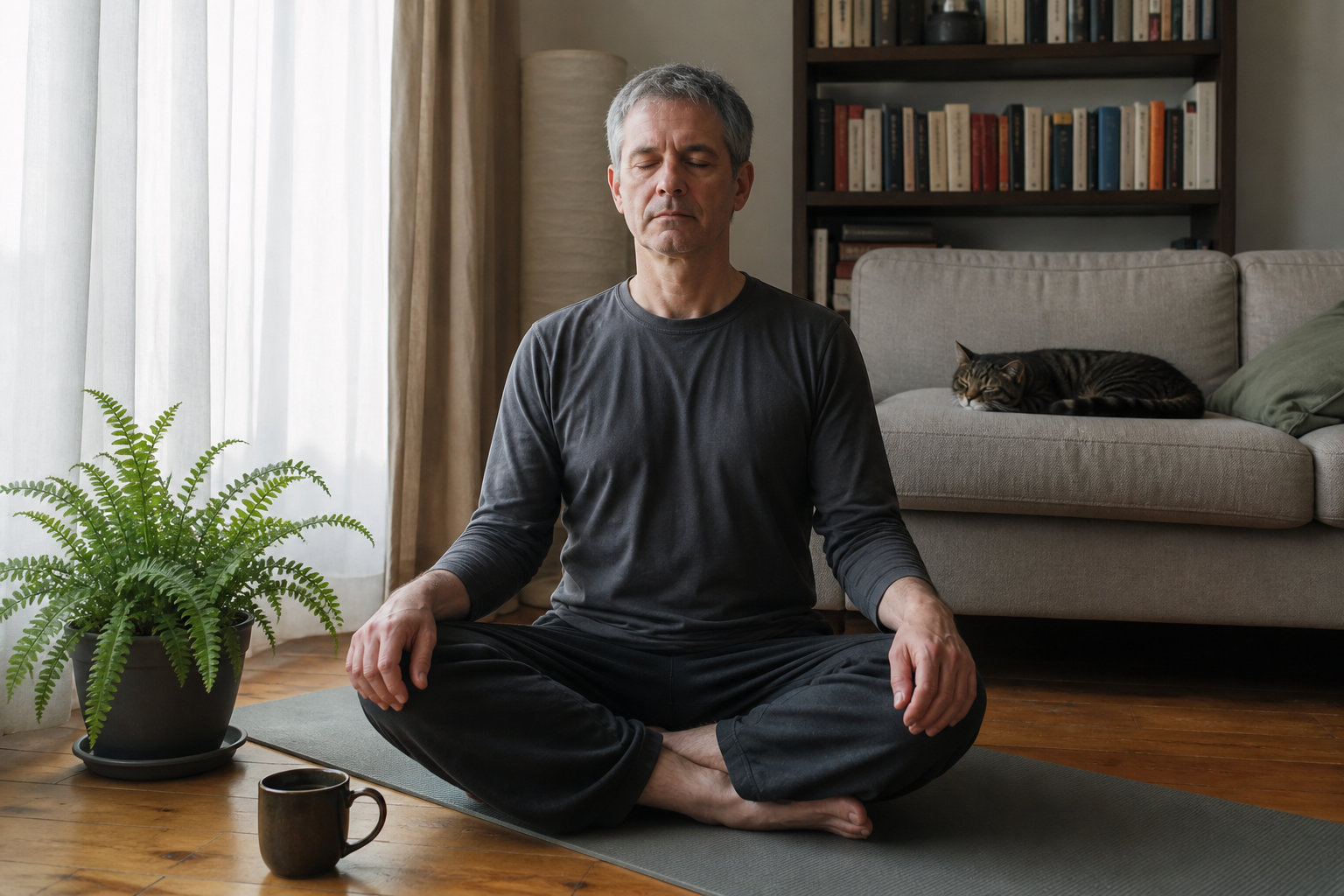
The chakra map can give a spiritual practice a series of places to pause: grounding, creativity, confidence, compassion, expression, insight and connection. You may understand these as subtle-energy centres, a meditative framework or both.
This guide uses the familiar seven-centre overview and offers a gentle question for each. It is not a medical map, a test for blockages or a promise that a ritual will treat symptoms.
Approach the map with context and choice
Chakra teachings belong to varied spiritual traditions, not one universal set of online colour meanings. A short overview cannot replace learning within a particular tradition. You can begin with curiosity while being clear about the kind of practice you are using.
The themes below are common contemporary associations. The locations describe the spiritual map, not separate anatomical organs. You do not need to force a sensation at any of them.
Seven centres, seven questions
Root · Muladhara
Base of the spine
Grounding and stability: What would help me feel a little more supported?
Notice the chair or floor supporting you, then name one practical need you can address.
Sacral · Svadhisthana
Lower abdomen
Creativity and enjoyment: Where could I allow a little more enjoyment or creative room?
Draw, cook, listen to music or choose another comfortable activity without needing a result.
Solar plexus · Manipura
Upper abdomen
Agency and confidence: Which choice is mine to make?
Write one decision you can take at your own pace, including the support or information you need.
Heart · Anahata
Centre of the chest
Compassion and connection: How can I offer care without abandoning a boundary?
Write a kind sentence to yourself or someone you appreciate; sending it is optional.
Throat · Vishuddha
Throat
Expression and listening: What would I like to say clearly and kindly?
Write the sentence before a conversation, then consider what you also need to hear.
Third eye · Ajna
Between the eyebrows
Insight and perspective: What am I noticing, and what am I assuming?
Describe a situation from two perspectives without deciding that either is the whole story.
Crown · Sahasrara
Crown of the head
Meaning and spiritual connection: What helps me feel connected with something larger than this moment?
Spend a few comfortable minutes in prayer, quiet reflection or attention to nature.
Choose one centre rather than doing everything
Read the questions and notice which one feels useful, not which one you think you ought to choose. If the throat theme draws your attention, you might spend a few minutes writing what you want to say. If grounding feels more relevant, begin with the practical support you need today.
You can work through the whole map over time, but there is no requirement to finish in seven days, reach the crown or return to the root before every session. A small practice is allowed to stand on its own.
A gentle session in four parts
- Settle: choose a supported position and let breathing remain comfortable.
- Focus: read one chakra question or use a word that fits your beliefs.
- Explore: write a few lines, sit quietly or try the suggested ordinary-life practice.
- Close: look around the room and choose one manageable action for later.
What if you hear that a chakra is blocked?
Ask what the person means and how the session is intended to help. A spiritual interpretation is not a confirmed diagnosis. It should not be used to explain a symptom, tell you to stop treatment or persuade you that an ordinary emotion makes you spiritually damaged.
You may find the language useful for describing an area of life that needs attention. You are also free to use different words. A difficult season can need compassion, practical change and support without becoming proof of an invisible fault.
Choose optional tools for meaning, not pressure
You may enjoy a colour, a piece of music, a crystal or a familiar prayer. Choose something that fits your practice and household. None is required, and an expensive object does not establish a stronger spiritual connection.
Keep this routine gentle: no forced breathing, breath holds or strenuous poses. You can leave your eyes open, change position or stop. If you want to learn more intensive yoga or breathwork, seek appropriately qualified guidance rather than treating this overview as instruction.
Keep your judgment when choosing a session
A paid practitioner may offer a clearly described spiritual, meditative or relaxation experience. Check what is included, the cost and your ability to pause or decline. A fee alone does not make a service fraudulent; neither does a spiritual label justify guaranteed cures or fear-based demands.
Be cautious if a supposed blockage requires urgent repeated payments, secrecy or withdrawal from medical care and supportive people. You do not need someone else’s permission to stop a practice that is not right for you.
Let the reflection become something kind and specific
Write one sentence about what you noticed and one action you might take. “Heart: I want more connection. I will ask a friend to meet” is a practical expression of a spiritual theme. It does not need to prove that an energy centre changed.
Return when it feels useful. The aim is a thoughtful relationship with your spiritual life, not a perfectly balanced score.
Chakra-practice questions
1. What are the seven chakras?
They are a widely used spiritual map of seven subtle centres, commonly named root, sacral, solar plexus, heart, throat, third eye and crown. Traditions and modern interpretations vary.
2. What does opening a chakra mean?
Practitioners use the phrase in different ways, often for bringing attention or a sense of flow to a centre. In this guide it means exploring a theme through a gentle practice, not forcing an energetic event.
3. Do all chakra traditions use the same map?
No. Different traditions describe centres and practices differently. The familiar seven-centre overview is useful to name, but should not be presented as every tradition’s complete teaching.
4. Which chakra should I begin with?
Choose a theme that feels relevant and manageable. If you are unsure, grounding and practical support can be a gentle starting point. You do not have to complete an entire sequence.
5. How long should I practise?
Begin with a few comfortable minutes. There is no universal deadline for opening or balancing a centre, and no need to continue until you feel a specific sensation.
6. Do I need special music, colours or crystals?
No. You may enjoy them as personal supports, but a quiet question and a notebook are enough for the reflective practices in this guide.
7. Do I have to visualize a colour?
No. You can use a word, an image, a prayer or simple attention to your surroundings. Difficulty visualizing is not a spiritual failure.
8. Can a chakra reading diagnose a health problem?
No. A spiritual interpretation is not a medical assessment. Symptoms need appropriate healthcare rather than an assumption about a blocked centre.
9. Does a difficult emotion mean my chakra is blocked?
Not necessarily. Emotions are part of life, and a colour or chakra label does not establish their cause. You can reflect spiritually while also attending to relationships, circumstances and support.
10. Should I force deep breathing or hold my breath?
No. This guide uses comfortable, natural breathing and no breath holds. Leave intensive breathwork to appropriately qualified instruction and consider your health needs.
11. Do I need yoga poses?
No. All the practices here can be adapted without a pose. If you want physical yoga, seek instruction that suits your abilities and do not push through pain.
12. Can I practise with my eyes open?
Yes. Looking at a familiar object or noticing the room may feel more comfortable than closing your eyes.
13. What if a practice makes me distressed?
Stop or change it. Return attention to the room, choose an ordinary activity or reach out for support. You do not need to endure distress to make spiritual progress.
14. Is every paid chakra session a scam?
No. Charging for a clearly described spiritual or relaxation service is not by itself proof of fraud. Be cautious of guaranteed cures, threats, secrecy and escalating payments to remove an unverifiable danger.
15. How do I know the practice was useful?
Look at what it helped you notice and the small choice that followed. You do not need a scan, a dramatic sensation or another person’s approval to reflect on whether the experience suited you.
While the article is informative, it would benefit from a more detailed explanation of how chakra balancing directly impacts one’s physical and mental health.
The descriptions of each chakra and their associated poses are quite thorough. Additional information on how to integrate these practices into a daily routine would be helpful.
This is a well-written article about the chakras and their significance. Including more information on the history and cultural context of chakras could enrich the reader’s understanding.
The practice of using yoga and meditation to open and balance chakras seems beneficial for overall health.
I agree. It’s always good to have methods for maintaining mental and physical balance.
Yes, incorporating these into a daily routine could be really grounding and centering.
The connection made between yoga practices and chakra balancing is instructive. However, it would be prudent to mention how these practices can be adapted for different levels of experience.
I found the parts about how to activate and balance each chakra quite enlightening. It adds a new dimension to my understanding of holistic health.
It would be interesting to see if there are any scholarly articles or studies that delve into the effects of chakra balancing and yoga.
The article’s approach to explaining chakra balancing is systematic. It would be useful to know about any potential side effects or contraindications for certain individuals.
This piece outlines practical steps for chakra activation and balancing. It would be interesting to see some scientific studies supporting these practices’ benefits.
The connection between chakras and emotional health is fascinating. I wonder how this intersects with modern psychological theories.
The step-by-step guides for balancing chakras are clear and concise. It might be beneficial to include some references to traditional texts or modern research that supports these techniques.
I appreciate the thorough guide on balancing the chakras, though I wonder about the scientific evidence supporting these practices.
The explanation of the chakras and their associated elements and mantras is quite detailed. It’s interesting to see how each one contributes to our well-being.
The instructions for balancing chakras are clearly written and seem easy to follow for those new to the practice.
The correlations between specific poses and chakras are well-noted, though practical application could vary based on individual needs.
Indeed. Personal experience and adaptation are key to effective practice.
I wonder if these practices need personalization for different physical and mental conditions.
The article provides a comprehensive overview of the chakras and their importance. However, the connection between physical health and chakra balancing seems to require further empirical validation.