

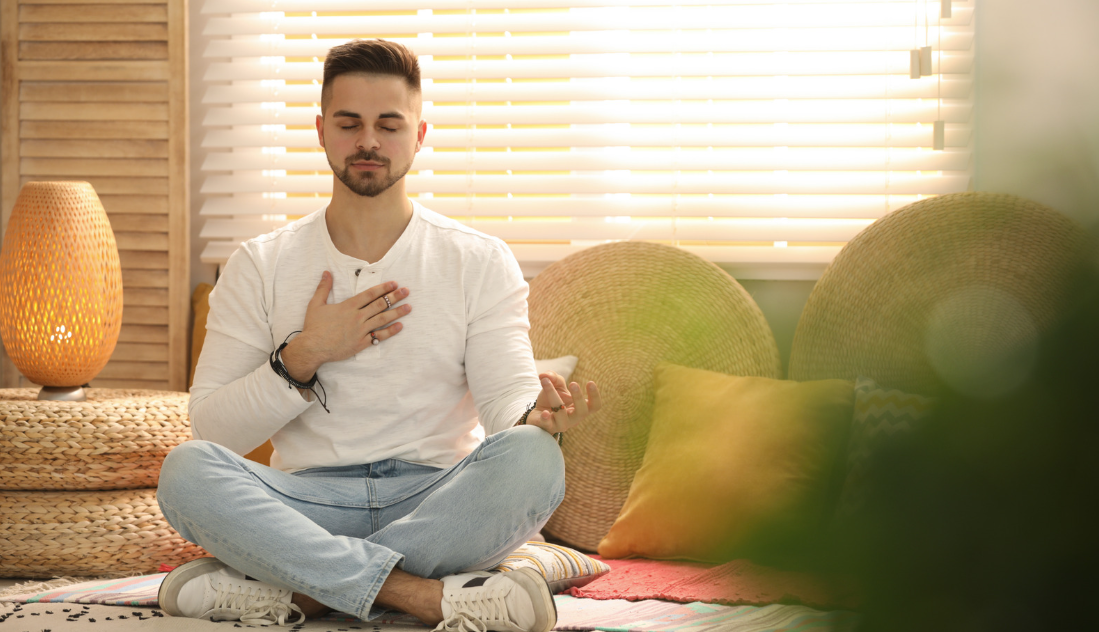
You do not need a long ceremony to pause and reconnect with yourself. A few minutes of gentle attention can give your spiritual practice a place in an ordinary day, whether you think of it as grounding your energy, prayer or a quiet return to the present.
This is a self-care ritual, not a method for healing an injury or curing an illness. The aim is to make space for yourself, not to produce a particular sensation or prove that you have done it correctly.
Settle somewhere comfortable
Choose a chair, a place to stand or another position that feels supported. Let your hands rest easily. You may keep your eyes open and notice the room; closing them is optional. There is no need for incense, a crystal or a special posture.
If you have only two minutes, shorten the routine. A brief practice that fits your day is enough. Do not do it while driving or during another task that needs your full attention.
Your five-minute practice
1. Arrive: the first minute
Notice where your body is supported: your feet in your shoes, your back against the chair or your hands on your lap. Name three things you can see. Let your breathing stay at a comfortable, unforced pace.
2. Choose an intention: the second minute
Try a sentence such as, “May I meet the next part of my day with steadiness.” If prayer is part of your tradition, use familiar words. If not, simply name the quality you want to bring with you: patience, kindness or clarity.
3. Bring attention to your hands: the third minute
Rest your palms together or leave them open. You may notice warmth, coolness, pressure or very little. Rubbing your hands can create warmth, but that feeling is not a test of healing power or a measurement of an energy field. Nothing is wrong if you feel no change.
4. Picture support: the fourth minute
If visualization suits you, imagine roots reaching gently into the earth or a soft light around your personal space. Let this be an image of support, not a barrier you must maintain to stay safe. If pictures do not come easily, focus on a word or the solid surface beneath your feet instead.
5. Return: the final minute
Look around, move your hands and choose one next action. Perhaps you need a drink of water, a short break or a clear message to someone. Close with your own words: “I can take the next step without doing everything at once.”
Adapt the ritual rather than pushing through
A quiet practice does not feel soothing to everyone on every day. If inward attention makes you uneasy, keep your eyes open, look at a familiar object or stop. Walking slowly in a safe place or speaking with someone supportive may suit you better.
Do not force deep breaths, hold your breath or press on a painful area. You do not need to repeat the ritual until a sensation disappears. The NCCIH overview of meditation notes that negative experiences can occur; discomfort is not a spiritual test you have to endure.
What about energy healing?
People use that phrase for several spiritual practices. Reiki, for example, involves hands placed lightly on or near the body. You may find meaning in a practice without treating it as a medical intervention. NCCIH reports that Reiki has not been clearly shown effective for health-related purposes and that evidence does not establish the proposed energy field.
Continue appropriate medical care for symptoms, pain or injury. A pause can accompany your care; it cannot tell you what caused a symptom, whether an illness is improving or whether you should change medication.
A closing question for your journal
Ask, “What do I need next that I can actually offer myself?” Write one answer, however small. Your ritual does not have to transform the whole day to be a worthwhile moment of attention.
The process outlined seems meditative and could likely help reduce stress, even if one doesn’t fully subscribe to the energy transfer concept.
The article provides a step-by-step guide for self-healing, which seems straightforward and easy to follow. I’m curious about the scientific support behind these methods.
While empirical evidence would be helpful, sometimes practices like this can be beneficial on a personal level even if not fully understood scientifically.
Indeed, it would be interesting to see some research-backed evidence to better understand the efficacy of these techniques.
I’m curious if there are any modern devices or applications designed to aid in self-healing practices as described in the article.
The idea of using intention and focus to facilitate healing is quite similar to concepts found in various ancient traditions. It’s interesting to see these ideas presented in a modern context.
Self-healing practices seem to center around mindfulness and positivity, which are universally beneficial. It’s good to be reminded of the body’s innate ability to heal.
Absolutely, practices that promote mindfulness can significantly improve mental and physical health by reducing stress and promoting relaxation.
Focusing on deep breathing and other mindfulness techniques can be incredibly grounding. I appreciate these reminders to be more present.
It’s intriguing that simple actions like smiling and rubbing hands together can create a sense of warmth and comfort. This could be very useful for enhancing one’s well-being.
The concept of energy transfer through the hands is fascinating. However, I’d like to learn more about how this energy is measured or observed.