

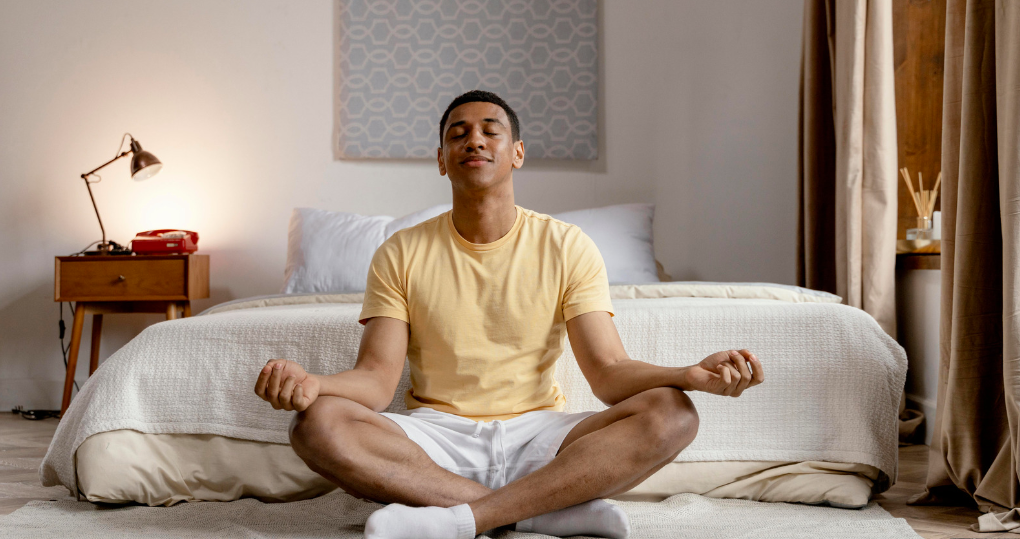
The phrase time-travel meditation can sound dramatic. In a gentle personal practice, it is a way to use imagination: picture a possible future, notice what matters and return with a question for your life now.
It does not change history, verify a memory or reveal a fixed future. You may give the imagery spiritual meaning while keeping those limits clear.
Begin with a possible future, not a painful scene
Choose an ordinary moment you would like to imagine: a calmer morning, a creative afternoon or a day with more room for connection. You do not need to revisit a distressing event to make the practice worthwhile.
If past experiences or memories are troubling you, seek qualified support rather than using a self-guided exercise to recover hidden events or work through trauma.
A short future-self visualization
- Settle comfortably and notice the room around you.
- Choose a future moment without treating its date as a prediction.
- Imagine one simple detail: where you are, what you are doing or how you are spending your time.
- Ask, “What quality matters to me in this picture?”
- Let the image fade and return attention to your surroundings.
- Write one small action that could express that quality today.
You can keep your eyes open or write instead of visualizing. If no picture comes, use a few words. The ability to see a vivid scene is not a measure of spiritual connection.
Notice the value, not just the scenery
An imagined home may point toward rest or belonging rather than a particular property. A future celebration may represent companionship or recognition. Ask what the picture means before turning it into a plan to buy or pursue something.
Then consider a practical step. If the theme is creativity, you might set aside a short period to make something. If it is connection, you could invite a trusted person for a conversation.
Let uncertainty stay in the picture
Your future involves circumstances and other people’s choices, not only intention. An image is a possibility you are exploring, not a promise you must manifest or a sign that a setback is your fault.
You may change what you want. Revisit the practice when it feels useful rather than trying to keep an imagined future intact at all costs.
What if a memory or message appears?
Note the experience without assuming its source or historical accuracy. A vivid image is not independent evidence that an event happened or that someone has sent guidance from another time.
Do not use an imagined scene to accuse a person, change treatment or make a major commitment. Take important questions back to information and support appropriate to the situation.
Return to the present if the practice becomes uncomfortable
Stop, look around and choose an ordinary activity. You do not need to finish the scene, force an answer or push through distress as part of healing. If the experience continues to trouble you, seek support.
A gentle practice can end with a simple thought: “I can care about the future and still live the next part of today.”
Meditation has numerous proven benefits, but the idea of time travel seems to stretch its capabilities.
Time travel as a metaphor for changing our mental and emotional states through meditation is an interesting viewpoint.
Yes, the metaphorical aspect can be quite powerful in helping individuals reframe their past experiences.
Indeed. The practice might be more about changing our narrative and emotional response to past events.
It seems more like a method to alter one’s perception and emotional response to past events rather than actual time travel.
The concept of time travel through meditation is quite intriguing. I wonder if there’s any scientific evidence to support these claims.
Agreed. While the mind is powerful, it’s important to differentiate between metaphoric and literal interpretations.
I share your curiosity. It would be interesting to see more studies on the impact of meditation on our perception of time.
The article highlights the power of the mind and the potential of meditation, but equating it to time travel might be a bit of an exaggeration.
While it may not be literal time travel, meditation can help people process past traumas and create a more positive outlook for their future.
The notion of time travel, even through meditation, requires a significant leap of faith for me. However, I’m open to learning more about the psychological benefits.
Using meditation to revisit past memories and reshape how we feel about them is an interesting technique, even if it doesn’t involve actual time travel.