

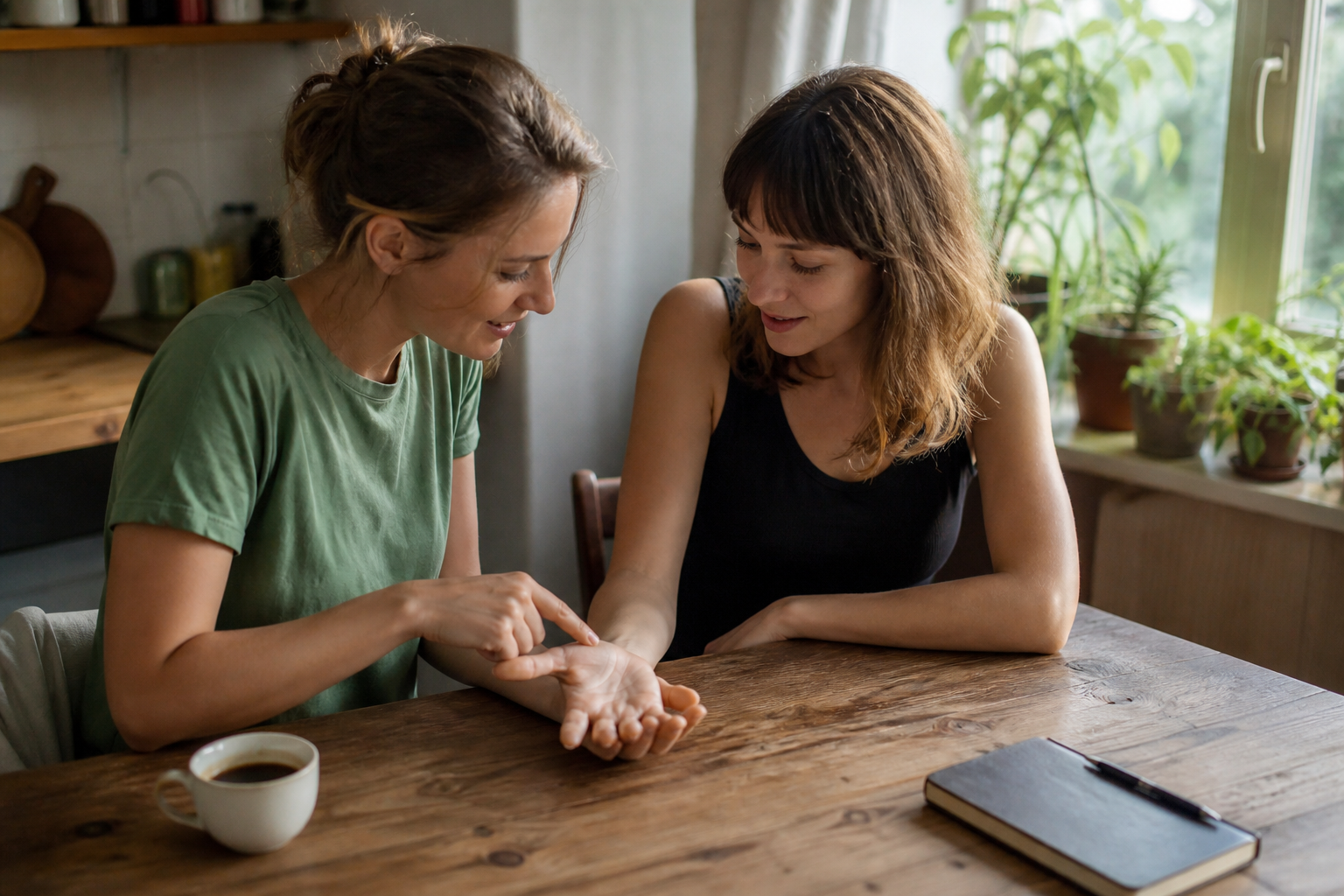
Palm reading begins with noticing, not announcing a destiny. If the practice interests you, start with a few familiar names and give yourself permission to learn slowly.
This guide uses a Western-style vocabulary as a simple introduction. Other approaches differ. The themes are symbolic interpretations, not diagnoses, personality scores or a timetable for your future.
Start with an agreement
If you are looking at another person’s hand, ask whether they want to participate. Explain that you are learning and ask which subjects they would prefer not to discuss.
You do not need to touch or photograph a hand to have a conversation. Do not save or share a picture without permission. A person can stop the activity without having to explain why.
Choose the hand—and say which convention you are using
Some readers use the dominant hand to discuss present expression and the other hand for background or potential; others compare both or follow a different convention.
There is no need to force a rule based on gender. State your approach and avoid treating differences between hands as proof of a hidden event.
Use ordinary light and a relaxed position. If a line is unclear, say so. Do not press, strain or keep searching for a mark that matches a preferred story.
Learn a few line names
| Name used in palmistry | Where a reader commonly looks | A theme for conversation |
|---|---|---|
| Heart line | The upper area across the palm, below the fingers. | Care, feelings and how you want to relate. |
| Head line | Across the middle area of the palm. | Thinking, learning and making choices. |
| Life line | Curving around the base of the thumb. | Vitality and how you experience your path—not years of life. |
| Fate line | A roughly vertical feature toward the centre of the palm, if visible. | Direction, work and how you think about circumstances. |
| Sun or Apollo line | A vertical feature below the ring finger, if visible. | Creativity, recognition or what you value in your contribution. |
| Relationship lines | Small features at the outer edge below the little finger. | The idea of close bonds—not a count of marriages or children. |
Real hands need not resemble a neat diagram. Lines can be faint, overlap or differ from a book’s illustration. An absent feature is not a sign that something is missing from your life.
Turn an observation into a question
Keep three parts separate: what you can see, the interpretation a system gives it and what the person actually says.
- Observation: “This feature looks curved to me.”
- Interpretation: “The approach I am learning connects this area with emotional expression.”
- Invitation: “Is there anything about expressing care that you want to explore?”
Do not turn a disagreement into proof that someone is “blocked” or hiding their true self. Their account of their own experience matters more than making your description fit.
Hand shapes and elements
Some modern approaches use earth, air, fire and water as broad labels for combinations of palm and finger proportions. Rather than deciding a person must have one temperament, use an element as a voluntary theme.
Earth: support
What would help me feel more practically supported?
Air: ideas
What would I like to understand or communicate?
Fire: initiative
What am I interested in beginning?
Water: feeling
What feeling would I like space to acknowledge?
These are our reflection prompts, not a measurement system. You do not need to classify your hand to use one.
What are the mounts?
“Mounts” are named areas of the palm in a reader’s map. In this vocabulary, Venus is associated with the base of the thumb; Jupiter, Saturn, Apollo and Mercury with the areas beneath the index, middle, ring and little fingers; and the Moon with the lower outer side.
A reader may connect those names with themes such as care, aspiration, responsibility, creativity, communication or imagination. A raised or flat area does not measure how much of a quality you possess.
Learn one map at a time and ask which book or school a teacher is using. You can study an old system without adopting its judgments about health, gender, class or someone’s moral worth.
A short reading to try privately
Choose one theme, such as care or direction. Look at the relevant area without assigning a prediction, then write a question it brings up. Answer from your actual life.
For example: “Where am I already receiving care?” and “Is there support I would like to ask for?” Finish with something you want to consider, not a promise that the palm has decided it.
If the practice becomes frightening or compulsive, pause it. You do not need to keep checking lines to prevent an event.
Do not read a lifespan, diagnosis or obligation
A short or broken life line is not a sentence about death. Do not use any line to diagnose illness, predict pregnancy, prove infidelity or tell someone how many children they must have.
For an actual physical symptom or change, consult a qualified health professional. A frightening palm prediction is not a reason to buy a remedy or postpone appropriate care.
Questions about learning palm reading
1. Can I learn a little palmistry without reading other people?
Yes. You can study the vocabulary and try private reflection without offering a session or sharing photographs.
2. Do I need special equipment?
No. Ordinary light and a comfortable view of your hand are enough for this introductory exercise. You do not need to buy a remedy or tool.
3. Which hand should I begin with?
Choose a convention and name it. Some readers use the dominant hand, others compare both; this is an interpretive choice, not a universal test.
4. Should I ask permission before looking closely at someone’s palm?
Yes. Ask whether they want to participate and respect their choice to decline or stop.
5. Must a reading involve touch or a photograph?
No. Ask what a session involves and state your preferences. Do not save or share another person’s photo without permission.
6. What if a line is faint or unclear?
Say that it is unclear. You do not have to find every feature in a diagram or force an interpretation.
7. What do I do if my hand does not match the illustration?
Use the map as vocabulary, not a requirement. Real hands vary, and an unclear or absent feature is not a personal deficiency.
8. How should I phrase an interpretation?
Separate what you observe from the symbolic theme, then offer an open question. Leave room for the person to disagree.
9. What if a description does not fit?
Accept that answer. Do not call the person blocked, dishonest or unaware of their true self to rescue the interpretation.
10. Are the four elements a compulsory classification?
No. Some approaches use them as broad labels. You can explore an element as a chosen reflection theme without classifying your hand.
11. What does mount mean here?
It is the name for an area in a palmistry map. The area is given a symbolic association, not a measured personality score.
12. Can relationship lines count marriages or children?
Do not treat them as a reliable count or as instructions about someone’s relationships or reproductive choices.
13. Should I read a child’s hand as a forecast?
No. Do not assign a child a lifespan, diagnosis, character verdict or unavoidable future from a palm.
14. What if I keep checking a line because I feel frightened?
Pause the activity rather than treating more checking as necessary for safety. Seek trusted and appropriate qualified support if the fear persists.
15. How can I end a reflective reading?
Summarise a question or idea the person found useful. Do not require agreement, a decision or another paid session.
The Fate Line’s association with life’s obstacles and successes provides an interesting perspective on predestination and free will.
The categorizations of the Heart Line and Head Line seem quite detailed.
Indeed, the specific points about the endings of these lines show precise observations.
While the descriptions are thorough, the scientific basis of palmistry remains uncertain, making me question its reliability.
The method of examining both hands for different insights adds a layer of complexity that could be worthwhile for those interested in this field.
The interpretation of the shapes of hands and fingers based on the elements is an intriguing aspect that I wasn’t aware of before.
The Life Line’s indications of vitality and health seem to correlate well with physical attributes.
Understanding one’s personality and life path through palm lines adds a unique dimension to self-reflection, despite the lack of empirical evidence.
The intricacies of palmistry are fascinating, and the distinctions between different cultural traditions add depth to the practice.