

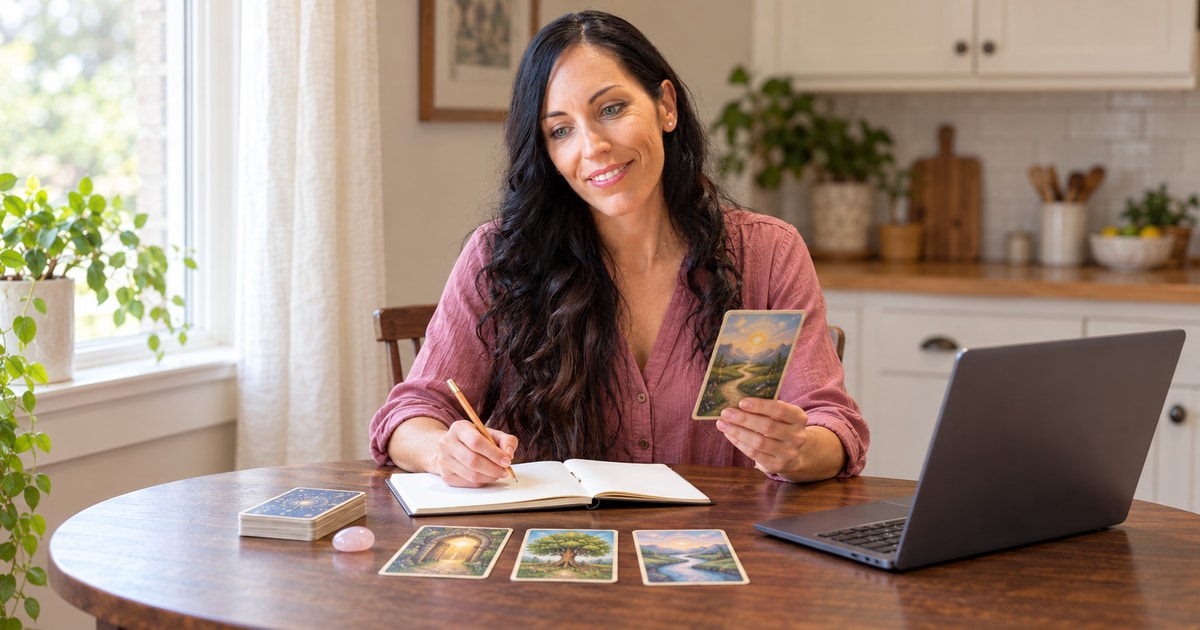
A reader describes a picture that comes to mind. A dream image stays with you, or a tarot scene seems to express something you could not quite put into words. In spiritual practice, these experiences may lead you to explore clairvoyance, often called clear seeing.
You can be curious about visual impressions without needing to prove that every image is a message. The useful starting point is to notice what happened, how you interpret it and what remains unknown.
Ask what the reader means by clear seeing
Some readers describe inner pictures, colours, symbols or imagined scenes. Others use the word more broadly. A description of their experience is not the same as independent confirmation of where it came from or what it predicts.
Before a session, ask how they work and whether they will explain their interpretation. You should be able to say that an image does not resonate without being pressured to invent a connection.
Separate image, interpretation and action
| Layer | An example | What to keep in mind |
|---|---|---|
| Image | A doorway comes to mind | Record the image before deciding what it means. |
| Interpretation | It reminds you of a possible change | That association is something to explore, not an established prediction. |
| Action | You gather information about an option | Choose using the practical information as well as your own values. |
The same symbol can mean different things to different people. A doorway might suggest opportunity, privacy, hesitation or simply a place you remember. A fixed symbol dictionary does not know your whole life.
Try a short observation practice
- Choose an ordinary object or a tarot image and look at it comfortably.
- Notice a few details without straining your eyes.
- Put it aside and write what you remember or what it brings to mind.
- Separate the details you actually observed from the associations you added.
This is an exercise in attention and reflection, not a certification of clairvoyance. You do not need sleep deprivation, intense breathing, staring at bright lights or a purchased activation.
Keep a journal that allows uncertainty
If you record impressions, date the entry and keep the original wording. Note the circumstances, the image, your first interpretation and other possibilities.
Later, include differences and non-matches as well as striking similarities. Do not stretch a vague image to fit an event simply because a match would feel reassuring. The journal can remain a place for curiosity rather than a score you must improve.
Do not rank yourself by the vividness of a picture
Your inner experience may be visual, verbal, sensory or difficult to describe. A faint image, no image or a preference for another practice does not make you less spiritual.
If an exercise feels uncomfortable, stop or change it. You are allowed to enjoy a card’s artwork, a prayer or a quiet thought without pursuing a dramatic experience.
Give visual symptoms practical attention
Seeing something that seems physically present but others do not see, or having new visual symptoms, deserves prompt medical assessment rather than an automatic spiritual explanation. The NHS guidance on hallucinations explains that such experiences can have different causes and should receive medical help.
Seek emergency help for sudden confusion or immediate danger. Do not stop medication or change treatment because a reader offers an interpretation.
Let meaning support rather than command
A visual impression can start a journal question or a conversation. It does not establish someone else’s consent, honesty, health or future.
Choose a reading that leaves you able to ask, disagree and think. Your own judgment remains part of the experience, even when a symbol feels deeply meaningful.
Questions about clairvoyance and visual intuition
1. What does clairvoyance mean in a spiritual reading?
It usually refers to receiving or interpreting visual impressions, often called clear seeing. Readers differ in how they describe the experience and the meaning they give it.
2. Is clairvoyance the same as seeing the future?
Not in every use of the word. A reader may describe symbolic imagery, a scene or an association rather than a future event. Ask what they mean and how they are interpreting it.
3. Do I have to see a detailed picture in my mind?
No. People describe their inner experience differently. You do not need to force a vivid image or judge your spiritual worth by how clearly you visualise.
4. Does an image prove that it came from a spirit?
No. An image may feel meaningful without independently establishing its source. Keep the experience and your explanation of it separate.
5. Can I practise noticing imagery?
You can try a comfortable observation or journal exercise. Treat it as a personal practice, not a test that certifies a psychic ability.
6. Should I close my eyes to practise?
Only if that feels comfortable. You can keep your eyes open, work from an ordinary object or choose a different form of reflection.
7. What if I do not notice anything?
You can stop without making the absence of an image into a failure or a blocked-energy diagnosis. Try another practice if you enjoy it more.
8. Can tarot help with visual reflection?
A card can give you an image to explore. Notice the scene and your associations without assuming that it establishes a fact about someone else.
9. How should I keep an impression journal?
Record the date, what you noticed, the interpretation and any uncertainty. Do not rewrite the original entry later to make it match an event.
10. Does a later coincidence confirm an impression?
A resemblance may feel striking, but a match alone does not settle the source or reliability of the impression. Record the differences and non-matches too.
11. Can a clairvoyant confirm cheating or secret feelings?
A reading is not independent confirmation of another person’s private behaviour or intentions. Use relevant evidence, direct conversation and your own boundaries.
12. Should I make a health decision from an image?
No. Seek appropriate healthcare for symptoms or concerns and do not change treatment because of a visual impression or reading.
13. Do I need to buy a crystal or activation?
No purchase is necessary for a simple journal or observation practice. Be cautious of expensive claims to unlock or certify an ability.
14. What can I ask before booking a clairvoyant reading?
Ask how the reader works, what the session includes, the full cost and whether you can decline a subject. Choose an offer you understand.
15. When should unusual visual experiences get medical attention?
Seek prompt medical assessment if you are seeing things that seem physically present but others do not see, or if you have new or concerning visual symptoms. Seek emergency help for sudden confusion or immediate danger.
Relaxation and deep breathing techniques being essential for receiving visions aligns well with many meditative practices.
Yes, these techniques are widely recognized for their ability to alter states of consciousness and focus the mind.
While the personal anecdotes are fascinating, it would be beneficial to have more empirical evidence supporting these claims.
The narrative style used to describe these experiences is compelling and adds a personal touch to the subject of clairvoyance.
The idea that photographs can capture faces in a static manner for a clairvoyant to describe is intriguing.
This could mean that clairvoyants might have a heightened ability to recall and interpret visual information.
Indeed, it suggests that clairvoyance might intersect with memory and perception in fascinating ways.
It’s interesting that the author mentions different styles of clairvoyance. This diversity suggests that the experience is highly subjective and personal.
I wonder if there are any neurological studies that correlate clairvoyant experiences with brain activity patterns.
The author’s journey in developing their clairvoyant abilities highlights the potential for personal growth and self-discovery through such practices.
The concept of clairvoyance as described seems to heavily rely on visual cues, which makes me ponder whether people with different dominant senses might experience it differently.