


Love can make a simple question feel urgent: Do they care? Will we reconnect? Am I ready to trust again? It is understandable to want a reading when your own feelings seem difficult to untangle.
You can bring those feelings honestly while shaping questions that leave you with something useful to consider. Focus on your needs, choices and possible conversations rather than treating a reading as independent access to another person’s private life.
Start with the question beneath the question
“Will they text?” may hold a deeper concern about uncertainty or effort. “When will I marry?” might be about belonging, family expectations or the kind of partnership you want.
You do not have to judge the first question as foolish. Write it down, then ask what you hope the answer would help you decide. That can reveal a more useful place to begin.
Try a question you can bring back into daily life
| The question on your mind | A more useful direction for the session |
|---|---|
| Do they love me? | What have I noticed, what do I need and what would I like to ask them directly? |
| Are they cheating? | What has affected my trust, and what information or support do I need? |
| Will my ex return? | What do I miss, and what would need to be different before I considered reconnection? |
| When will I get married? | What does commitment mean to me, and which choices are available now? |
| Are they my soulmate? | How does this connection feel in ordinary life, and what does the label mean to me? |
| Should I send a message? | What am I hoping the message will achieve, and is contact welcome and safe? |
| Why does nobody want me? | Which experience has left me feeling unwanted, and what kind of support or connection would I welcome? |
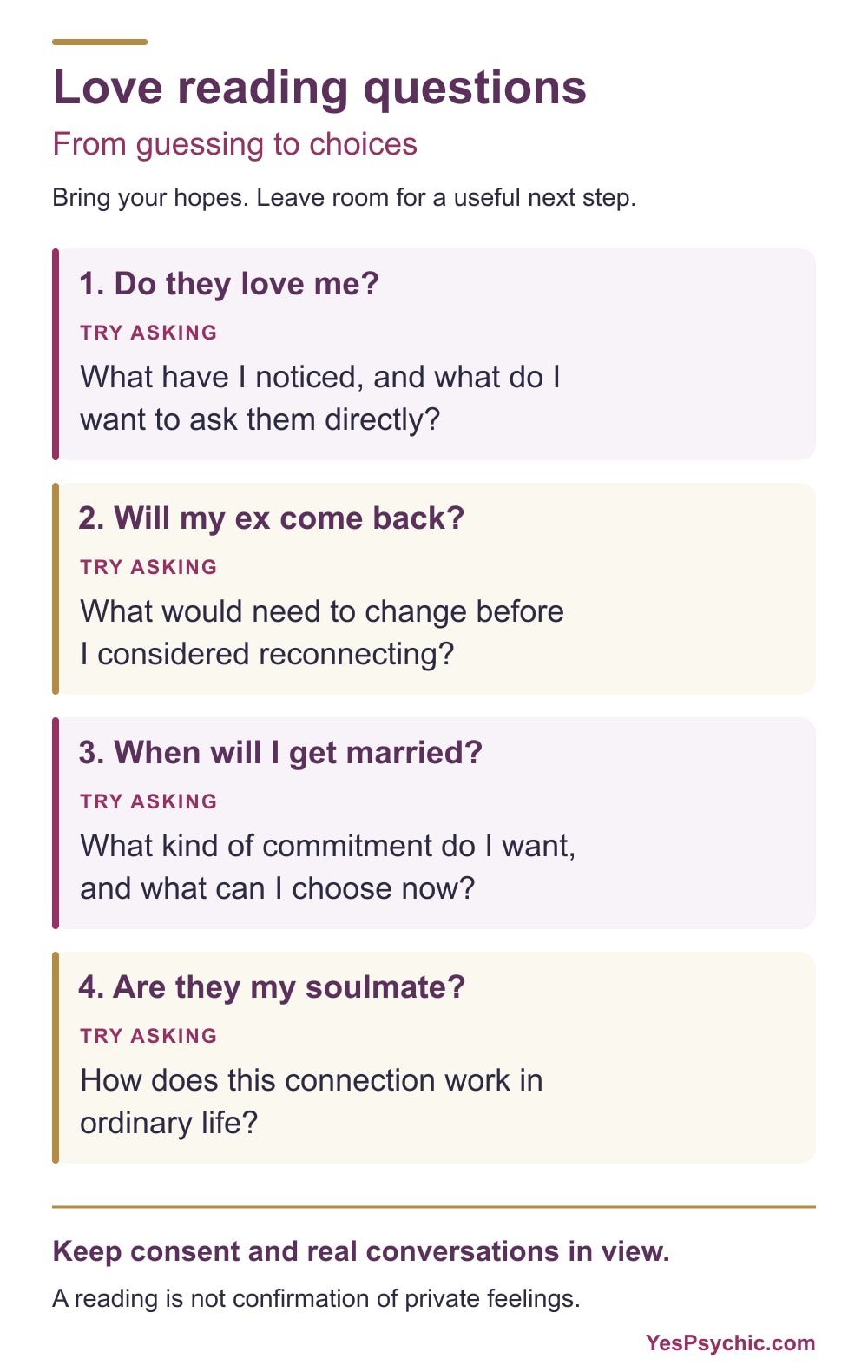
These are starting points, not a script you must follow. The best wording is specific enough to reflect your situation and open enough that you can consider more than one possibility.
Keep an interpretation separate from a fact
A reader may offer imagery, a theme, a possibility or a question you had not considered. Ask what they mean and whether they are describing an interpretation or claiming a verifiable fact.
A card is not proof of cheating, a reunion date is not an appointment, and a soulmate label does not establish consent. Keep consequential relationship choices connected to what actually happens and what the people involved freely communicate.
You do not need to decide that a whole session was worthless if one interpretation does not fit. Nor do you have to force it to fit to justify the time you spent.
Prepare a few boundaries before you book
- Choose your main topic. Write the decision or feeling you want to explore.
- Set a time and spending limit. Confirm the current rate and how billing ends.
- Choose what stays private. You can decline questions and avoid sharing sensitive information.
- Ask about the format. Find out whether the reader uses tarot, conversation or another approach.
- Leave room to pause. You do not need to book again immediately to complete an interpretation.
A helpful session should allow you to ask questions and disagree. Pressure to accept every statement is not a requirement of being spiritually open.
A three-question love reflection
1. My needs
What matters to me in this connection that I have not clearly named?
2. My choices
Which option can I consider without controlling someone else’s answer?
3. My next conversation
What would I like to ask, express or set a boundary around?
You can use these in a reading or a private journal. You do not need a particular card to give you permission to have a need.
Be careful with promises to change someone else’s feelings
A reader may charge for their time. That is different from a guarantee that additional payments will bring a person back, remove an urgent threat or make them love you.
Secrecy, frightening claims and pressure to keep paying are reasons to stop and seek independent support. A word such as “block” is not, by itself, enough to establish fraud; consider the actual claim, conduct and payment demand.
If you believe you were scammed, contact the payment company promptly and keep relevant records. The FTC’s recovery and reporting guide explains options for different payment methods. Do not assume a promised refund or recovery service is genuine.
When another kind of support should come first
If you are afraid of a partner, being threatened or monitored, a reading cannot determine the safest way to respond. In the United States, contact the National Domestic Violence Hotline at 1-800-799-7233 or text START to 88788, using a communication method that is safe for you.
Its personalized safety-planning guidance is a more appropriate starting point than a prediction about whether the relationship will improve. For immediate danger, contact local emergency services.
Leave with room to think
After the session, note what felt useful, what did not fit and which facts are still unknown. A welcome insight may be a clearer question rather than a definite forecast.
Choose an action only if it suits the circumstances. You may decide to talk, gather information, take time or do nothing. The session does not have to become a command.
Questions about preparing for a love reading
1. What is a useful first question for a love reading?
Begin with the issue you actually want to explore, such as what you need in a partnership or which conversation you are avoiding. You do not need to cover your whole love life in one session.
2. Am I wrong to want to ask whether someone loves me?
No. Wanting reassurance is understandable. A more useful reading question may be what you have noticed, what remains unclear and what you want to ask the person directly.
3. Can a reading confirm someone else’s feelings?
Do not treat an interpretation as independent confirmation of private feelings. The person’s own words, choices and consent still matter.
4. What can I ask instead of whether an ex will return?
Consider what you miss, what would need to change and whether renewed contact would be welcome and safe. A reading cannot provide the other person’s agreement.
5. Can cards confirm cheating?
A card or impression is not evidence of cheating. Avoid making an accusation on that basis; consider the actual concern and seek information or support appropriate to the situation.
6. Should I ask for a wedding date?
You can explore your hopes about commitment, but do not treat a date offered in a reading as a scheduled event. Marriage involves decisions and circumstances beyond the session.
7. What can I ask about a soulmate or twin flame?
Ask what the label means to you and how the relationship functions in daily life. A meaningful label does not cancel either person’s freedom to decline or leave.
8. How much background should I share?
Share what you freely want to discuss and ask how the reader works. You do not need to reveal sensitive details, passwords or documents, and you can leave a topic private.
9. Do I have to agree when an interpretation does not fit?
No. You can say that it does not resonate, ask for clarification or move on. You do not have to invent a connection to make the reading successful.
10. How many questions should I bring?
Choose a small number that fits the time you intend to book. Prioritize the one that matters most instead of extending the session simply to finish a long list.
11. Should I keep asking the same question?
Notice whether another session would add something useful or mainly provide temporary reassurance. You can pause without receiving a final prediction.
12. What should I check before paying?
Confirm the full rate, any introductory limits, how billing starts and stops, and any relevant cancellation terms. Decide your own spending and time limits.
13. Can I ask for a tarot spread about my next step?
Yes. You might ask about your needs, an option and a conversation to prepare. Keep the spread focused on reflection rather than establishing another person’s secret thoughts.
14. Can a ritual make a specific person return?
Do not treat a ritual or paid promise as control over someone’s consent. You can use a personal ritual to reflect or mark a change without expecting it to compel contact.
15. Are all paid love readings scams?
No. A reader can offer a clearly described, priced session. Threats, secrecy, escalating payments and guaranteed control over an outcome are reasons to pause and seek independent advice.
16. What should I do if I think I paid a scammer?
Contact the company used to make the payment promptly and ask what recovery options are available. Keep relevant records and use official consumer-protection reporting guidance. Recovery is not guaranteed.
17. What if I feel afraid of my partner?
Prioritize appropriate safety support and a personalized plan. A reading is not a safety assessment, and you do not have to confront the person to prove that something is wrong.
18. How can I use the session afterward?
Write down a useful question, what remains unknown and one optional next step. You can consider the interpretation, disagree with it or decide no action is needed.
I find the suggestion to use full names rather than nicknames when referring to people intriguing. It probably helps the psychic connect more accurately with the energies.
Limiting the number of questions per subject is a good strategy. It prevents the session from becoming overwhelming and ensures a focused reading.
I appreciate the emphasis on being specific when asking questions. It makes sense that this would provide more accurate and useful insights.
The suggestion to write down questions beforehand is sound advice. It ensures that you cover all the important aspects during the reading.
It’s interesting that the article suggests focusing on one topic at a time. This seems like a practical approach to getting the most out of a reading.
The advice to be prepared for unexpected information is valuable. It ensures you’re mentally ready for whatever comes up during the session.
The article provides a comprehensive list of potential questions to ask a psychic. It’s crucial to have clarity on what you seek from a session.
The mention of free minutes on online sites is quite helpful. It provides an opportunity to establish a connection with the psychic without immediate financial commitment.