

Quick guide
A happy life is less about a constant good mood and more about a few basics that keep you steady: regular sleep, some movement, decent food, people you actually talk to, something that feels worth doing, and limits on how much news and scrolling you take in. Research on mental health supports these basics as self-care that helps most people cope with stress and feel better day to day. What research does not support is the idea that a mindset trick, an energy practice or a reading can make you happy on its own. Change usually feels uncomfortable before it feels good, so this guide starts small, with a minimum version of each habit that you can still do on a hard day. Saying no, protecting your time and being honest with yourself count as self-care too. If low mood lasts for more than two weeks, or you lose interest in things you normally enjoy, self-care is still useful but it is not enough, and talking to a doctor or calling or texting 988 is the next step.
Most advice about happiness asks you to think differently: be positive, be grateful, stop worrying. Those are reasonable goals, but they skip the part that actually moves the needle for most people, which is how you sleep, move, eat, connect and spend your attention. Your brain is built to notice threats and problems first, because that kept your ancestors alive. It is not built to hand you contentment as a default setting. That is not a flaw to fix. It just means that feeling good is something you support with daily conditions rather than something you talk yourself into.
This guide collects what the research on wellbeing points to, puts it into a table you can use tonight, and then covers the two things that most often get in the way: fear of change and trouble saying no. It ends with a clear line between ordinary low days and the kind of low mood that needs more than habits.
What research-backed self-care actually looks like
The phrase “self-care” has been stretched to cover everything from bubble baths to expensive retreats. The version supported by health research is plainer. The National Institute of Mental Health describes self-care as taking time to do things that help you live well and improve both your physical and mental health, and its list is short: regular physical activity, regular healthy meals and enough water, making sleep a priority, a relaxing activity you return to, setting goals and priorities, practicing gratitude, noticing positive moments, and staying connected to people. You can read the full guidance on the NIMH page about caring for your mental health.
Two things stand out in that list. First, nothing on it costs money or requires a special belief. Second, every item is a behavior, not a feeling. You do not have to feel motivated to take a ten-minute walk, and the walk tends to help whether you felt like it or not. That is the quiet logic behind the rest of this page: do the small physical and social things first, and let your mood follow at its own pace.
A ten-minute daily reset
- Body firstDrink a glass of water, eat something with protein in it, and get a few minutes of daylight, ideally before you open your phone.
- Move a littleWalk to the end of the street, stretch while the kettle boils, or take the stairs. Five minutes counts.
- Reach one personSend a message that asks a real question, or say hello to a neighbor or coworker and wait for the answer.
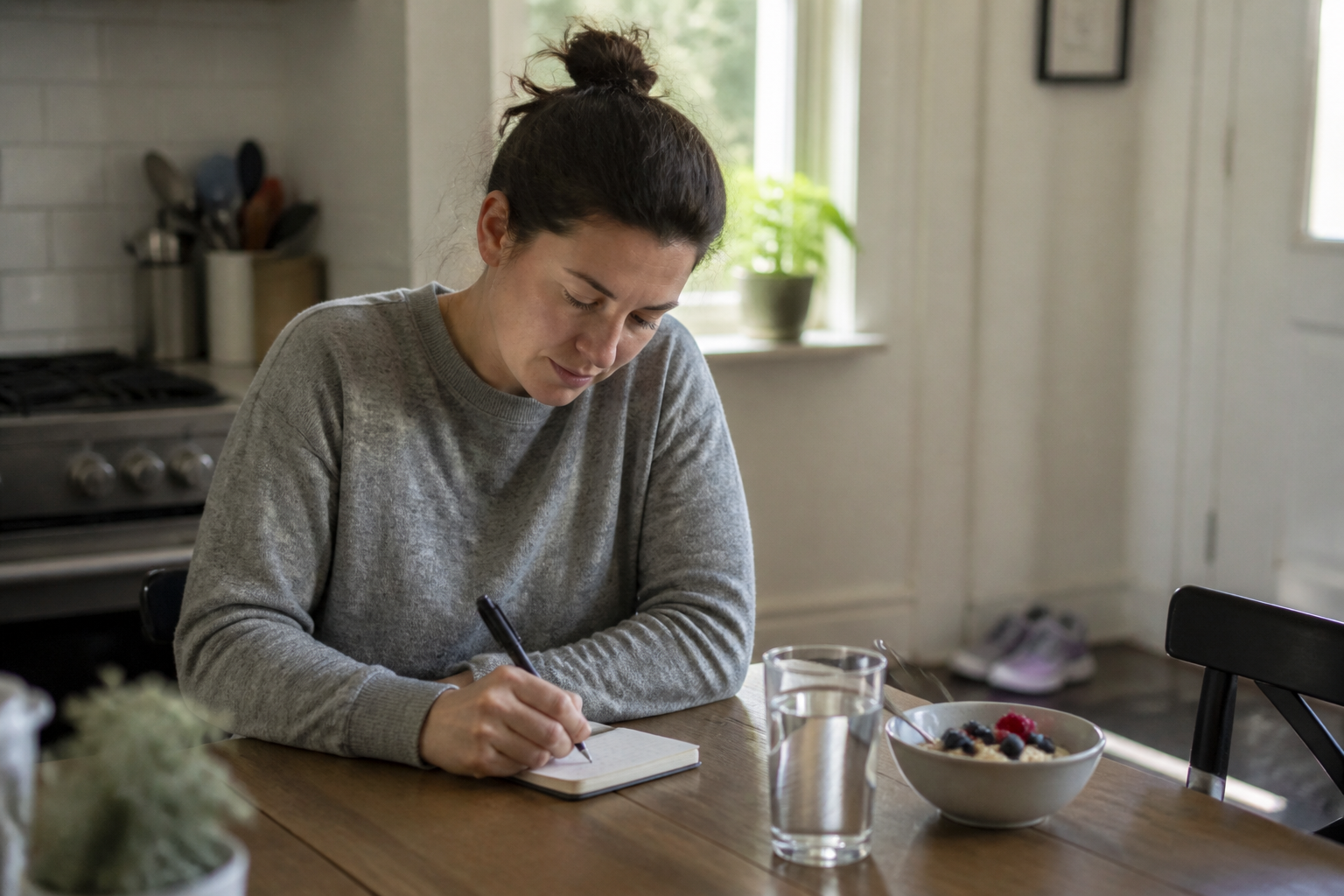
- Write one lineNote one thing that went okay today and one small thing you plan to do tomorrow. Close the notebook.
Four small actions that cover sleep, movement, connection and purpose without needing a good mood to start.
The daily basics, with a minimum version for hard days
The full version of each habit below is what you aim for on an ordinary day. The minimum version is what you do when you are tired, sad, busy or sick. The point of a minimum is that it keeps the habit alive, so you are not starting from zero every time life gets heavy.
| Area | What helps on a normal day | Minimum version on a hard day |
|---|---|---|
| Sleep | Same wake time every day, screens dimmed an hour before bed, a cool and dark room, and caffeine finished by early afternoon. | Keep your usual wake time even after a bad night, and leave the phone outside the bedroom. |
| Movement | Twenty to thirty minutes of walking, cycling, swimming, gardening or anything you will actually repeat. | Five minutes: a lap of the block, two trips up the stairs, or a slow stretch on the floor. |
| Food | Regular meals with some protein and vegetables, water through the day, and not skipping breakfast or lunch. | One real meal that includes protein, eaten sitting down, with a glass of water beside it. |
| Connection | Time face to face or a proper phone call with someone you trust, and being honest when they ask how you are. | One text that asks a real question, or two minutes of small talk with a person you see anyway. |
| Purpose | Working on something that matters to you, learning a skill, helping someone, or finishing a task you chose rather than one assigned to you. | Complete one small thing you decided on, such as watering a plant or returning an email. |
| News and social media | Set windows for checking, no phone at the table or in bed, and unfollow accounts that reliably leave you feeling worse. | One news check instead of five, and the phone charges in another room tonight. |
Notice that the minimum versions are almost embarrassingly small. That is deliberate. On a hard day, the goal is not to improve your life. The goal is to keep the floor from dropping. People who keep a floor under their habits tend to recover faster when the hard stretch ends, because they do not have to rebuild everything.
Why fear of change keeps people stuck, and what to do about it
Almost everyone who wants a happier life can name at least one change they have been avoiding: a conversation, a job search, a move, a habit. The reason is usually not laziness. Change asks you to give up something predictable for something uncertain, and your brain treats uncertainty as a cost even when the current situation is making you unhappy. The familiar misery feels safer than the unfamiliar improvement.
You cannot remove the discomfort, but you can make it smaller and shorter. The steps below are the ones that tend to work.
- Name the actual fear. “I am scared of change” is too vague to act on. Write down what you are really afraid of: losing a routine, being judged, failing in public, not being able to go back. A named fear can be planned around. A vague one just hums in the background.
- Shrink the first step until it is boring. If the change is a new job, the first step is updating one line of your resume, not applying. If it is a hard conversation, the first step is writing the opening sentence. Boring steps do not trigger the alarm.
- Keep the rest of life steady. Change one thing at a time and leave your sleep, meals and routines alone while you do it. Stability in the background makes the change in the foreground feel less dangerous.
- Expect the dip. New situations feel worse before they feel normal. For most people that awkward stretch lasts a few weeks. Knowing it is coming stops you from reading it as proof that you made a mistake.
- Set a review date, not a verdict. Decide in advance when you will look at how the change is going, for example in six weeks. Until then, you are gathering information, not judging yourself.
- Tell one person. Saying the plan out loud to someone you trust makes it real and gives you a place to report back. It also makes it harder to quietly drop.
Saying no without guilt
A surprising amount of unhappiness comes from saying yes to things you did not want: extra shifts, favors, events, roles in other people’s dramas. Every yes spends time and energy that you then cannot give to sleep, movement, friends or the work you care about. Learning to say no is not selfish. It is how you keep the basics in the table above from being crowded out.
- Buy time. “Let me check and get back to you tomorrow” is a complete answer. It stops you from agreeing on reflex.
- Keep it short. “I can’t take that on this month” needs no backstory. Long explanations invite negotiation.
- Offer a smaller yes when you want to. “I can’t host, but I can bring dessert” protects the relationship without costing your weekend.
- Say no to the task, not the person. “I’d like to help and I don’t have the room right now” keeps the door open for next time.
- Let the silence sit. After you decline, you do not have to fill the pause or apologize twice. The other person will usually move on faster than you expect.
- Do not invent a lie to soften it. Lies have to be remembered and tend to unravel. A plain “I’m not able to” is kinder and simpler.
- Do not say yes to avoid five seconds of awkwardness. Those five seconds are cheaper than the weeks of resentment that follow a yes you did not mean.
- Do not treat someone else’s disappointment as an emergency. People are allowed to be a little let down. That is part of being an adult with their own plans.
Thoughts that quietly work against you
Habits and boundaries do most of the work, but a few mental patterns deserve a mention because they undo progress. Comparison is the first. Social feeds show you other people’s highlights, edited and timed for effect, and your brain compares them with your unedited Tuesday. The fix is not to feel differently about the feed. It is to see less of it, which is why the news and social media row is in the table.
Perfectionism is the second. If a walk only counts when it is thirty minutes, you will skip it on the days you most need it. The minimum versions exist precisely to break that rule. The third is harsh self-talk. If you would not say it to a friend who was having a hard week, it is not a useful thing to say to yourself. You do not need to replace it with forced positivity. Neutral and factual is enough: “That went badly. Here is what I’ll try next.”
When low mood needs more than self-care
Everyone has flat days and bad weeks. The habits on this page are built for exactly those. There is a point, though, where self-care is still useful but no longer sufficient. The National Institute of Mental Health lists signs that low mood may be depression rather than an ordinary rough patch: a sad, anxious or empty mood most of the day for more than two weeks, losing interest in things you used to enjoy, sleeping or eating much more or less than usual, feeling tired or slowed down, trouble concentrating, feelings of worthlessness or guilt, and thoughts of death or suicide. The full list and treatment options are on the NIMH page about depression.
If that describes you, the next step is a conversation with a doctor or a licensed therapist, not another habit. Depression is common and treatable, and the sooner it is addressed the shorter it tends to last. If you are having thoughts of harming yourself, call or text 988 in the United States to reach the Suicide and Crisis Lifeline, which is free and available around the clock. You can also read about it at 988lifeline.org. If you are in immediate danger, call 911. A psychic reading can be a comfortable way to talk things through, but it is not a substitute for care from someone trained to help with depression.
Key takeaways
- Happiness is supported by daily conditions, mainly sleep, movement, food, connection, purpose and limits on news and scrolling, more than by changing how you think.
- Every basic has a minimum version for hard days, and keeping that floor matters more than doing the full version perfectly.
- Fear of change shrinks when you name the specific fear, make the first step boring, and set a review date instead of demanding an instant verdict.
- Saying no protects the time your wellbeing habits depend on, and a short plain no works better than a long apology.
- Low mood that lasts more than two weeks or includes losing interest in life needs a doctor or therapist, and 988 is there for anyone having thoughts of self-harm.
Related reading
- How to Find Happiness
- Things That Affect Your Happiness
- Why You Fear Change
- Let Go of Fear and Have Fun
- How to Say No with Confidence
- Do Not Be an Enemy to Yourself
- Food, Sleep and Mood
- Planning for the Future
Frequently asked questions
1. What is the simplest way to start living a happier life?
Pick one row from the daily basics table and do its minimum version every day for two weeks. Most people choose sleep or movement because the effect shows up quickly.
2. Does positive thinking make you happy?
Noticing good moments and practicing gratitude are on the NIMH self-care list and do help a little. Forcing yourself to feel positive while ignoring sleep, food and connection tends not to work.
3. How much sleep do adults need to feel well?
Most adults do best with seven to nine hours. A consistent wake time matters almost as much as the total, because it anchors the rest of your day.
4. Is a five-minute walk really enough to make a difference?
On a hard day, yes. Five minutes keeps the habit alive and often leads to a longer walk once you are outside. On ordinary days, aim for twenty to thirty minutes.
5. Why do I feel worse after scrolling social media?
Feeds show you other people’s edited highlights, and your brain compares them with your unedited day. Seeing less of the feed works better than trying to feel differently about it.
6. What should I do when I am too tired to do anything?
Do the minimum version of one habit: a glass of water, a short stretch, one text to a friend. Then rest without guilt. Rest is part of the plan, not a failure of it.
7. Why am I so afraid of change even when I am unhappy?
Your brain treats uncertainty as a cost, so a familiar unhappy situation can feel safer than an unfamiliar better one. Naming the specific fear and shrinking the first step reduces that reaction.
8. How long does it take for a change to feel normal?
For most people the awkward stretch lasts a few weeks. Setting a review date about six weeks out gives you enough time to judge the change fairly.
9. How do I say no without feeling guilty?
Keep it short, skip the backstory, and let the pause sit. Guilt usually fades faster than the resentment that follows a yes you did not mean.
10. Is it selfish to put my own wellbeing first?
No. The time you protect for sleep, movement and friends is what lets you show up properly for other people. Running on empty helps no one.
11. Can food really affect my mood?
Skipping meals, eating very little protein and running low on water all make it harder to concentrate and stay steady. Regular meals help more than any single special food.
12. What counts as purpose if I do not have a big goal?
Purpose can be as small as finishing a task you chose, learning something new, or helping one person. It is the sense of having picked something, not the size of it.
13. How do I stop comparing myself to other people?
Reduce the input first by limiting feeds and unfollowing accounts that leave you worse. Then compare yourself with your own last month instead of with someone else’s best day.
14. What is the difference between a bad week and depression?
A bad week lifts with rest and time. Depression involves low mood or loss of interest most of the day for more than two weeks, often with changes in sleep, appetite and energy, and it needs a doctor or therapist.
15. Who should I contact if I am having thoughts of self-harm?
In the United States, call or text 988 to reach the Suicide and Crisis Lifeline, free and open around the clock. If you are in immediate danger, call 911.
16. Can a psychic reading help me be happier?
A reading can be a structured way to talk through what is weighing on you and what you want to change. It cannot predict your future or replace medical or mental health care.
17. Do I need to meditate to be happy?
No. A relaxing activity you return to is helpful, and meditation is one option, but a walk, music, gardening or reading can fill the same role.
18. What if I try these habits and still do not feel happy?
Give them a few weeks, keep the minimum versions going, and talk to a doctor if low mood or loss of interest continues. Needing more help is common and nothing to be ashamed of.
Evidence note: The self-care basics on this page follow the guidance published by the National Institute of Mental Health on caring for your mental health, and the signs of depression follow the NIMH depression page. The minimum versions of each habit and the steps for handling change are practical suggestions drawn from that guidance and from common behavioral advice, not clinical protocols. Ideas such as energy, manifesting or readings shaping your mood are beliefs and interpretive frameworks, and research does not support them as causes of wellbeing. If low mood lasts more than two weeks, or you have thoughts of self-harm, contact a doctor or call or text 988 in the United States.
The article provides a practical guide towards achieving happiness. I appreciate the emphasis on mindfulness and recognizing small victories.
Focusing on positive thoughts for at least 40 days is an interesting concept. I wonder if there are any studies to back this up.
Hanging out with happy people can indeed positively affect one’s mood. It’s an aspect of social dynamics worth considering.
It’s true that money cannot buy happiness. Spending wisely and on meaningful experiences can contribute to well-being.
The suggestion to be creative doesn’t always resonate with me as I don’t consider myself artistic, but the article makes a valid point about finding joy in various activities.
The notion of not striving for perfection is a liberating one. It’s important to understand that it’s okay to be imperfect.
Balancing work and fun sounds easier said than done, but it’s a crucial aspect for sustained happiness. Good reminder!
Living in the now is something many struggle with. The article’s advice to appreciate the present moment is very practical.