


Worry can make an ordinary decision feel urgent or keep returning after you think you have answered it. You do not have to respond to every thought immediately, and struggling with anxiety does not mean you lack faith or discipline.
A few flexible practices may help with day-to-day worry. They are not a cure, a diagnosis or a test you must complete before asking for professional support.
Name the concern without deciding it is a fact
Try: “I am having a worry about money,” rather than “Everything is about to go wrong.” Then ask whether there is a practical issue that needs attention.
If a bill is due, checking the amount or asking about available support may be useful. If the thought is an unanswerable prediction about every future bill, repeatedly arguing with it may not give you new information.
You do not have to force the thought away. You can choose a next activity while acknowledging that uncertainty is uncomfortable.
Try a brief time to work through worries
The NHS describes a “worry time” technique: put concerns into words and set aside a short period to consider them.
If you try it, choose a manageable time rather than a strict performance target. Ask what you can act on now, what could be planned for later and what is outside your control. Write one practical step where there is one.
Do not postpone a safety issue, urgent symptom or genuine deadline until a scheduled reflection period. If the practice increases distress or becomes another ritual you feel forced to repeat, stop and discuss alternatives with an appropriate professional.
Three possible next steps
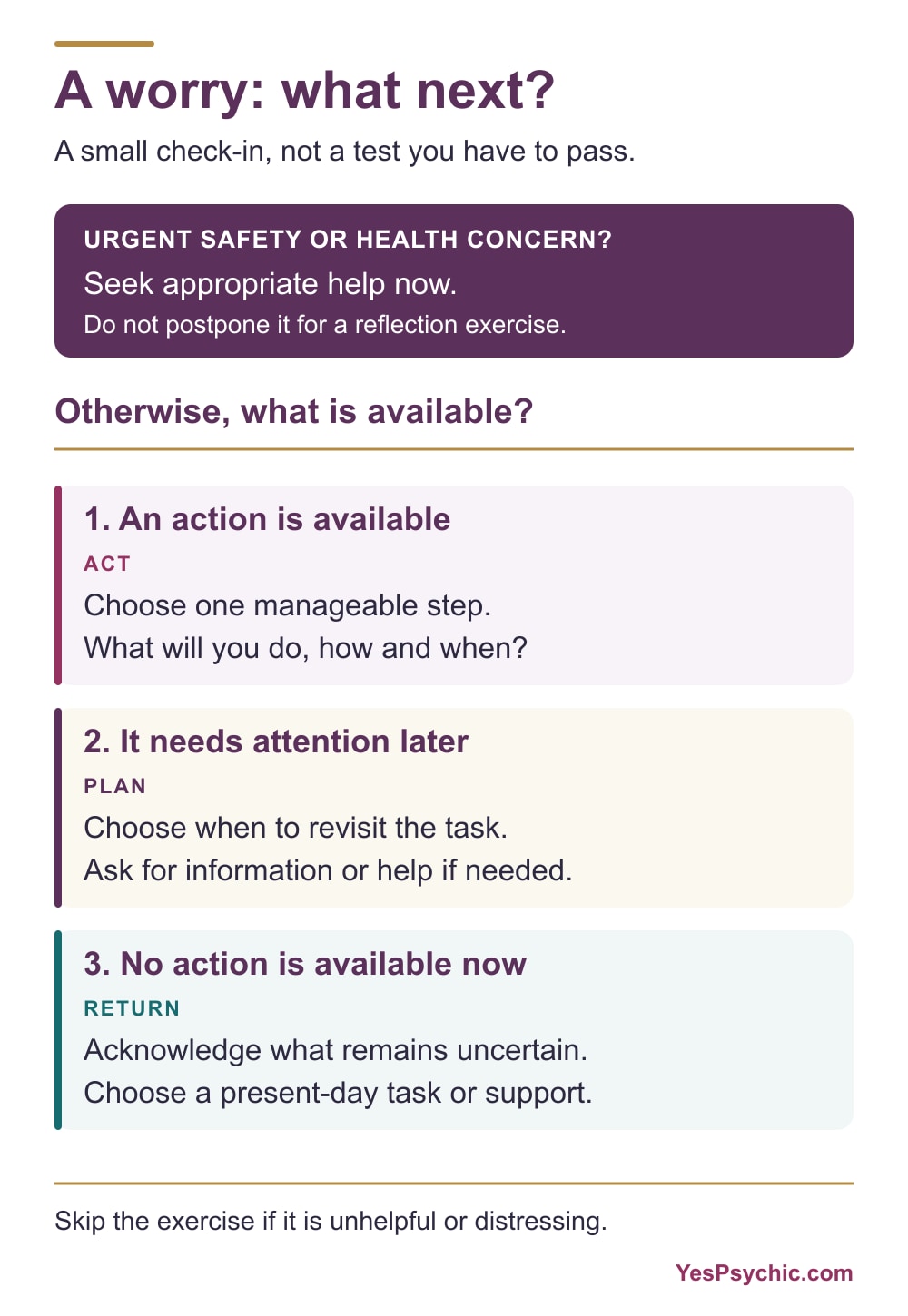
Address an urgent safety or health concern with appropriate help now. For other worries, you can use this short map if it feels useful:
- An action is available: choose one manageable step and consider what you will do, how and when.
- It needs attention later: choose when to revisit the task and ask for information or support where needed.
- No action is available now: acknowledge the uncertainty and choose a present-day task or support.
Skip the exercise if it is unhelpful or distressing.
Support ordinary needs in a way that fits you
Rest and routine
Consider a sleep routine you can realistically manage. Work patterns, health and caring responsibilities may require adaptation.
Food, drink and movement
Keep regular nourishment in view. Notice whether caffeine or alcohol affects how you feel, and choose accessible movement that suits your health and circumstances.
Company and practical help
If there is someone safe to ask, request a conversation or a concrete task. Support need not mean discussing every worry.
These are options, not a checklist that makes you responsible for eliminating anxiety. Missing a walk or having a difficult night does not explain every feeling or mean you failed.
Choose a present-moment practice that feels comfortable
You might notice your feet on the floor, look around the room or name a few ordinary things you can see. A gentle breath may suit you, but you do not need to hold your breath, force a long exhale or close your eyes.
If focusing inward makes you feel worse, stop and try another form of support. You can also skip a practice altogether.
Keep spirituality supportive, not compulsory
A short prayer, a familiar reading or a quiet moment may be meaningful. They do not need to become repeated tests that you are safe or spiritually protected.
If repeated psychic sessions are mainly an attempt to obtain certainty, you can pause bookings and consider what practical information or support is missing. A prediction is not confirmation that a feared event will or will not happen.
Ask for professional care when you need it
NIMH distinguishes ordinary worry from anxiety disorders. A qualified healthcare professional can help assess persistent, intense or difficult-to-manage anxiety and discuss suitable care.
You do not have to wait until daily life is impossible or complete a fixed period of self-help first. Seek urgent medical help for symptoms that may be a medical emergency rather than assuming they are anxiety.
In the United States, call or text 988 for crisis support. For immediate danger, use local emergency services.
Observing one’s thoughts as a method to deal with anxiety makes a lot of sense. It’s a practical approach to mindfulness.
The idea of becoming an observer of one’s thoughts rather than the thinker is intriguing. It offers a new perspective on dealing with anxiety.
The article’s suggestion to dismiss the idea of controlling or suppressing thoughts is valuable. It aligns well with mindfulness practices.
It’s interesting that the article discusses how habitual anxious thoughts can lead to a negative spiral. Breaking this habit seems essential.
Indeed. Identifying them as habits rather than inevitabilities can empower individuals to make changes.
Agree. Recognizing these thought patterns as habitual can be the first step toward managing them.
The explanation about how attempts to control anxious thoughts can actually exacerbate them is very enlightening.
Learning to let thoughts come and go, like clouds dissipating in the sky, can be a useful metaphor for managing anxious thoughts.
Yes, it’s a powerful visual that can help in practicing letting go of anxious thoughts more effectively.
Absolutely. Visual metaphors like this can be very helpful in implementing the concept in daily life.
The distinction between real fear and anxious thinking is crucial. Understanding this difference can help in addressing anxiety more effectively.
The strategies mentioned, such as distracting oneself or thinking positively, often provide temporary relief but aren’t long-term solutions.